The Great Disaster Maafa, The African Holocaust: Truth & AccountabilityThe Great Disaster ~ Maafa, The African Holocaust: Truth & Accountability

Between the 15th and 19th centuries, European states and their business elites built a transatlantic system that kidnapped at least 12.5 million Africans. This was not the work of rogue traders. It was a coordinated project of monarchies, parliaments, chartered companies, banks, insurance firms, and industrial consumers. Many of those institutions still operate today.

"This page presents evidence, not opinion. The sources include the institutions' own commissioned research, university databases, central bank reports, and government archives. The ledger is open. The evidence is in their own records."
I. The Catastrophe

The Scope of the Crime

Between approximately 1492 and 1888, European powers collectively organized the largest forced migration and system of dehumanization in recorded history. Around 12.5 million African men, women, and children were forced onto slave ships from West and Central Africa. About 10.7 million survived the Middle Passage to the Americas. Millions more died during capture, forced marches, and imprisonment on the African coast.

This was a continental European enterprise, not the work of a single nation.

46.7%
Portugal/Brazil
26.1%
Britain
11%
France
8.5%
Spain
4.8%
Netherlands
2.4%
United States
0.5%
Denmark & Others

Source: Trans-Atlantic Slave Trade Database, slavevoyages.org

The total human, cultural, and economic cost to Africa, and to the descendants of the enslaved across the Americas, is beyond calculation. The Brattle Group, an economic consultancy, has estimated the economic value of the transatlantic slave trade at $100–131 trillion in present-day terms.

The most devastating element was not only physical violence, but the deliberate destruction of identity. Families were broken at auction. People were separated from those who spoke their language. African names were replaced with European ones. Spiritual traditions were suppressed. Drumming was banned. Teaching enslaved people to read or write was criminalized. These policies were designed to sever people from ancestors, culture, and memory so completely that human beings could be turned into legal property.

Law by law, this status was codified: statutes that made slavery hereditary through the mother; laws that ensured Christian baptism did not confer freedom; laws that legalized killing during 'correction'; codes that classified human beings as real estate.

Stage 1

The Capture, West African Village Raids (c. 1650–1800)

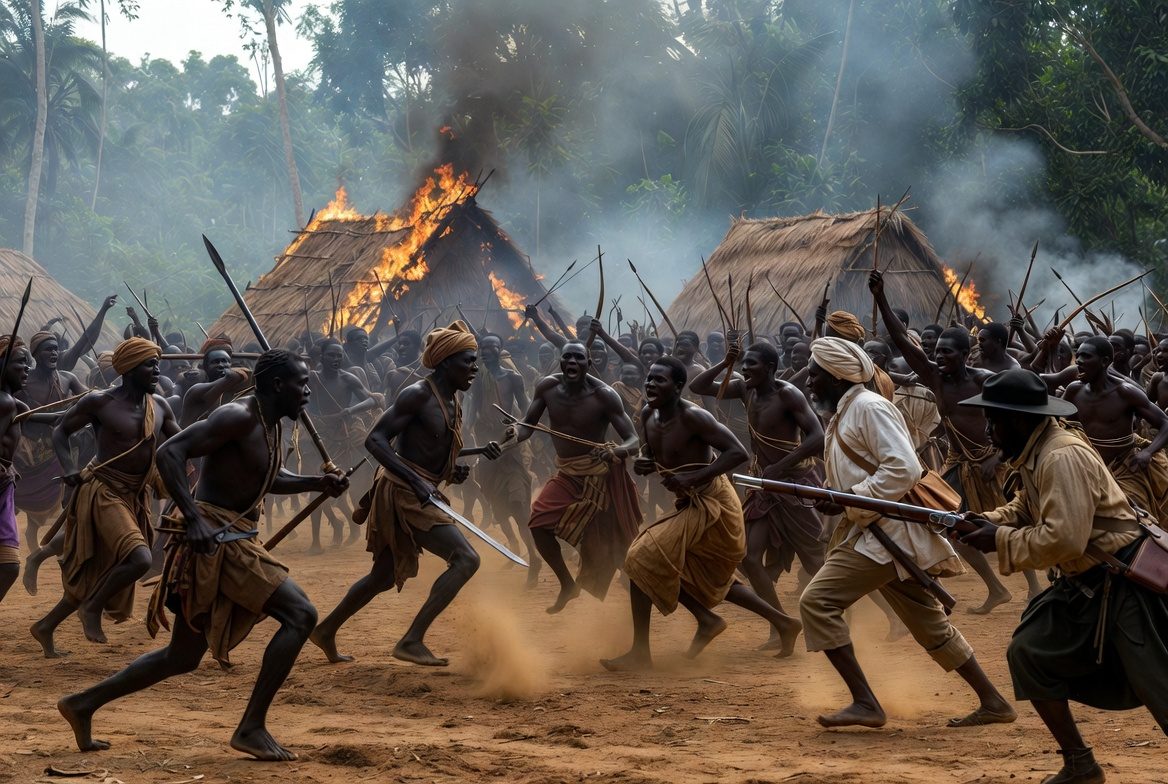
Slave raiders, often backed by coastal kingdoms trading with Europeans, attacked inland villages. Millions were seized this way. These images depict the sudden violence that began the Maafa.

Depiction of a West African village raid by slave raiders, showing armed attackers storming a village with burning huts, documenting how millions of Africans were captured and forced into the transatlantic slave trade.
Armed raiders storm an inland village, seizing captives as dwellings burn. These attacks were systematic, not random, coordinated with European demand for enslaved labor.
Depiction of captured Africans fleeing a burning village during a slave raid, men, women, and children driven from their homes at spearpoint in the opening act of the Maafa.
Entire communities uprooted in minutes. The captured would be marched to the coast, a journey many would not survive, before being loaded onto slave ships bound for the Americas.
Stage 2

The Forced March, Journey to the Coast

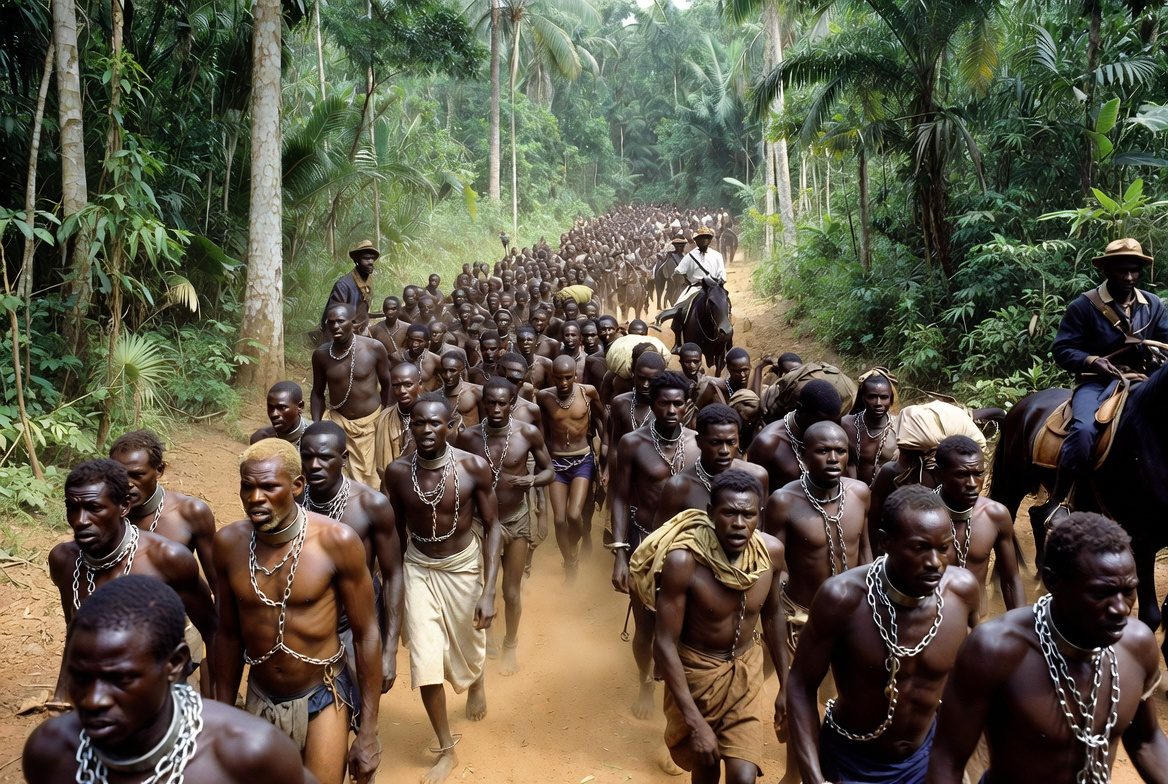
Captives walked hundreds of miles in chains (coffles). Many died from exhaustion, hunger, or beatings before reaching the sea. These images depict the brutal overland trek that claimed countless lives.

Chained African captives marched through dense jungle on a dirt path, guarded by armed slave traders on horseback, depicting the coffle system used to transport millions to coastal slave forts.
Chained in coffles, neck-to-neck iron links, captives were marched hundreds of miles through forest and savanna. Those who collapsed were left to die or killed on the spot.
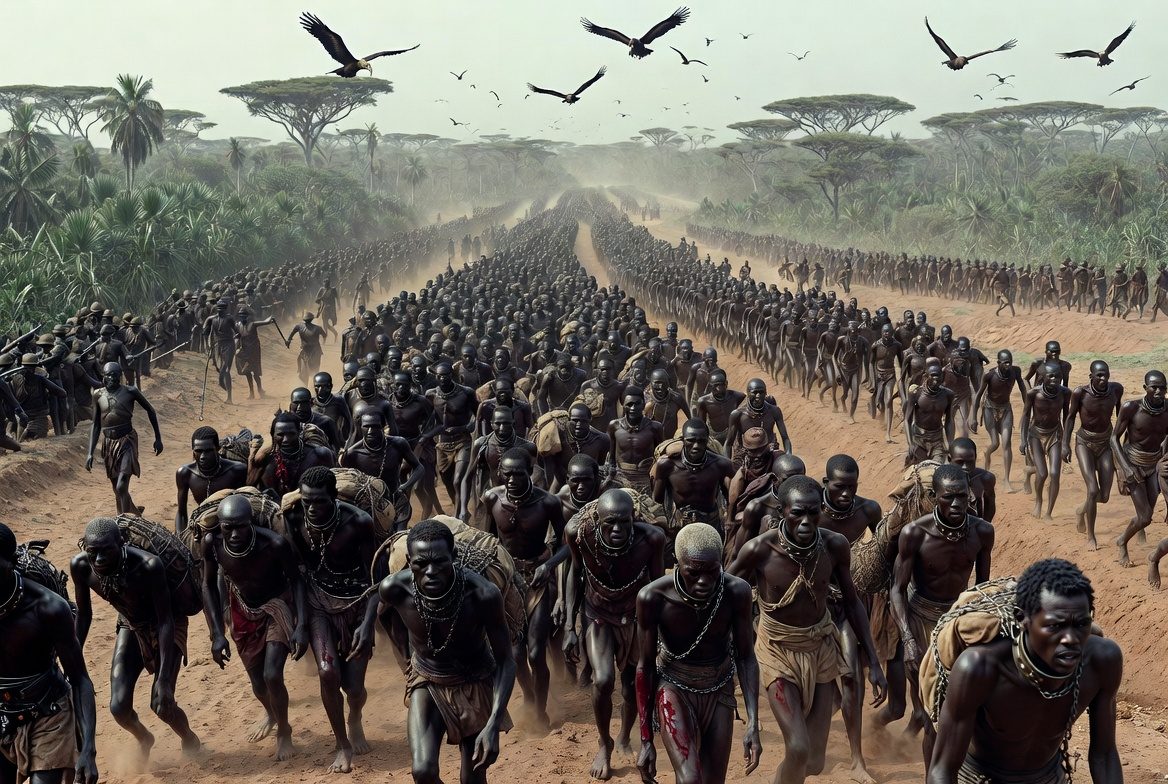
Vast columns of chained Africans stretching to the horizon on a dusty road, with vultures circling overhead, depicting the massive scale of the forced march to the coast during the transatlantic slave trade.
The scale was staggering. Columns of captives stretched to the horizon. An estimated 20% died on these forced marches before ever reaching the coast, their bodies left along the trail.
Stage 3

The Barracoon, Waiting in the Slave Fort

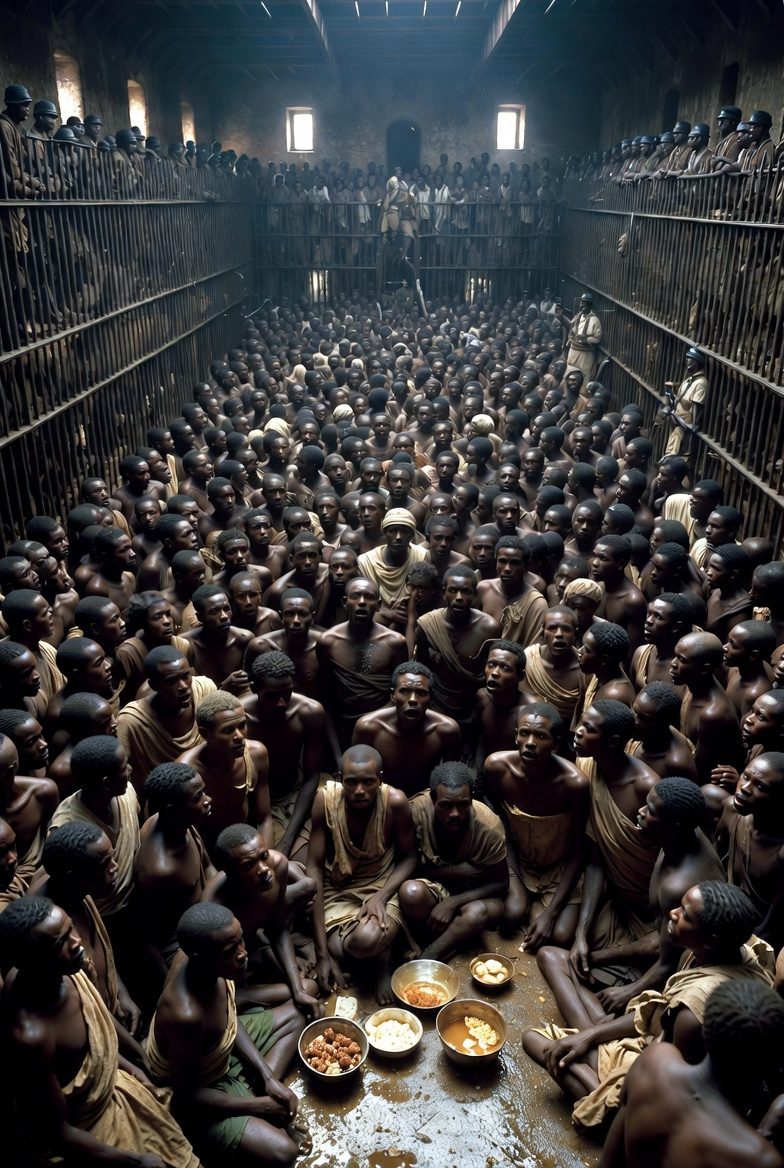
Prisoners were held for weeks or months in filthy coastal dungeons or pens, inspected, branded, and prepared for sale to ship captains. Disease and despair spread rapidly here.

Hundreds of African captives packed into a barracoon, a coastal holding pen, awaiting inspection and sale to European slave ship captains. Guards watch from elevated platforms.
Barracoons, coastal holding pens, warehoused hundreds of captives at a time. People were inspected like livestock, branded with hot irons, and sorted by age and physical condition for sale.
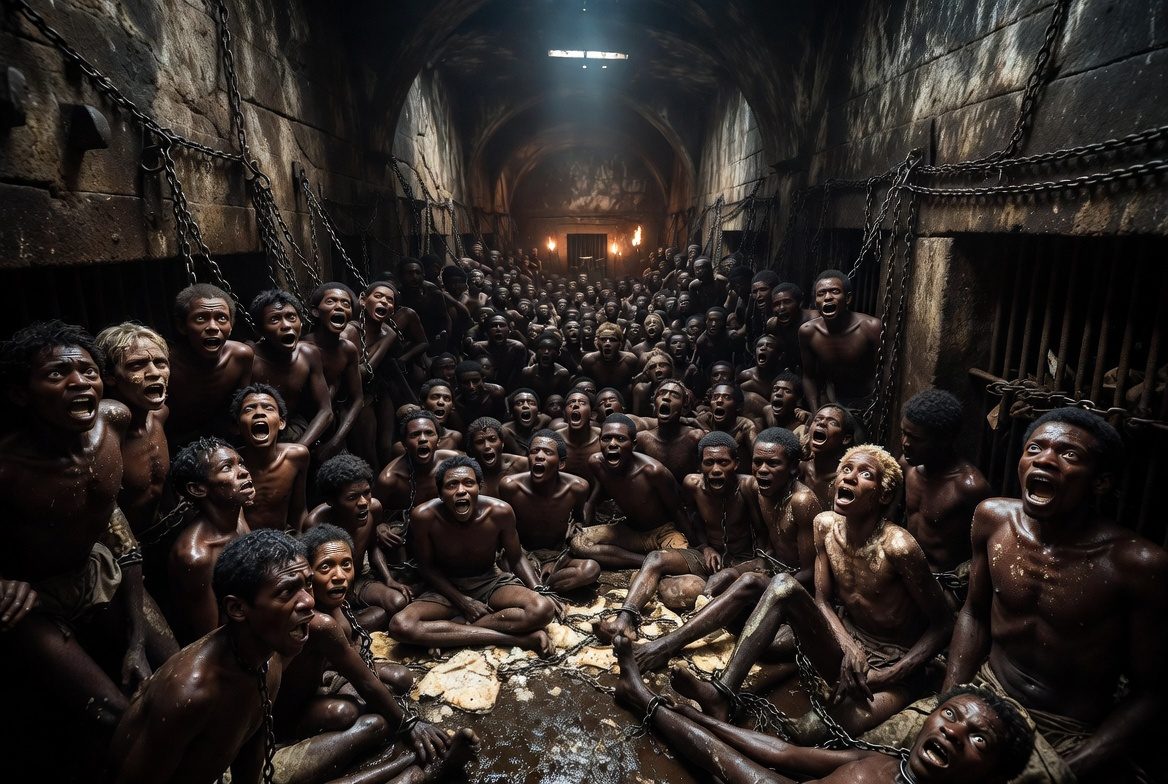
Chained African captives crammed into a dark stone dungeon beneath a coastal slave fort, crying out in anguish, depicting the subterranean holding cells where people were imprisoned before the Middle Passage.
Beneath the slave forts, stone dungeons held captives in total darkness for weeks or months. Disease spread rapidly in the airless cells. Many never emerged, their remains still lie beneath forts like Elmina and Cape Coast Castle.
Stage 4

Loading onto the Slave Ship

Once sold to European captains, captives were packed aboard. The journey across the Atlantic, the Middle Passage, awaited, where conditions were designed to maximize profit at the cost of human life.

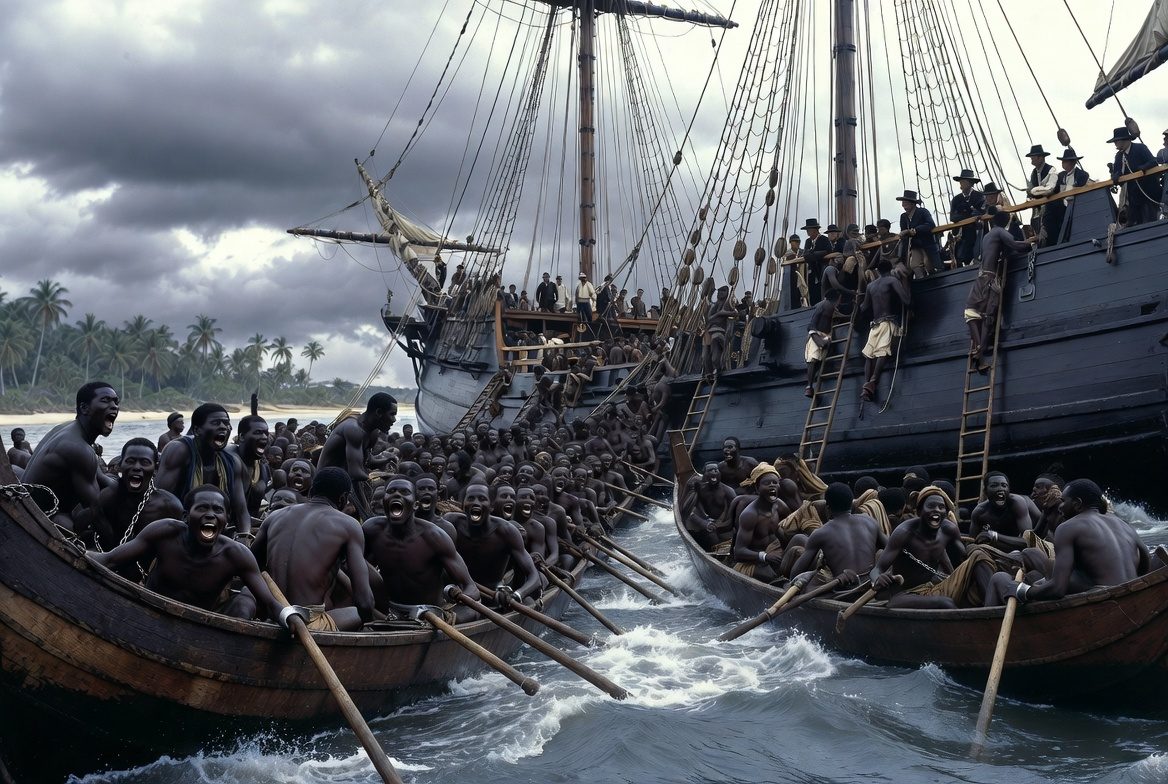
Enslaved Africans being forced into longboats and loaded onto a European slave ship anchored off the West African coast, the beginning of the Middle Passage across the Atlantic.
After weeks in the barracoons, captives were ferried by longboat to slave ships anchored offshore. Packed into overcrowded vessels, they faced the horrors of the Middle Passage, a voyage of 6 to 12 weeks across the Atlantic where roughly 15% perished from disease, suffocation, and despair.
Stage 5

The Middle Passage

This was the heart of the horror: 10–12 weeks of unimaginable suffering. Ships like the Zong threw living people overboard to claim insurance. The stench, screams, and death were constant.

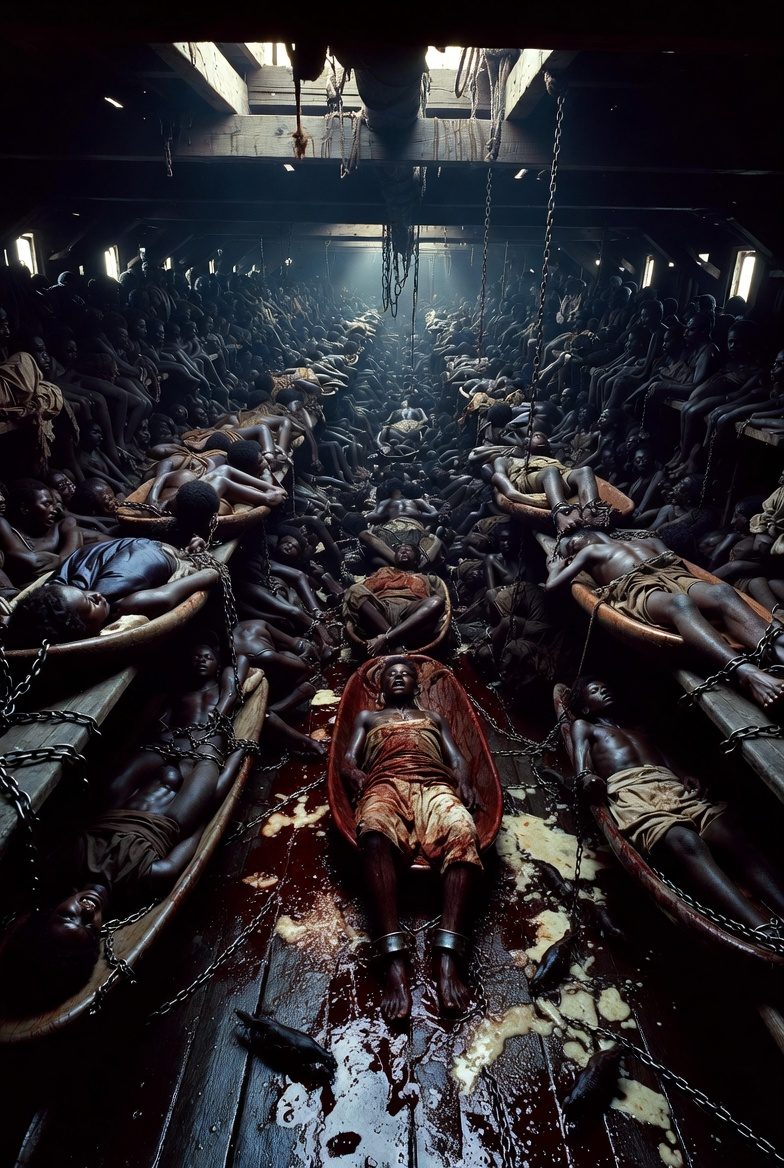
Interior of a slave ship during the Middle Passage, hundreds of enslaved Africans chained in rows below deck in horrific, overcrowded conditions.
Below deck, captives were packed so tightly they could not sit upright. Chained together in sweltering darkness, they lay in filth for months. Disease, dysentery, smallpox, and scurvy, swept through the holds, killing up to 25% on some voyages.
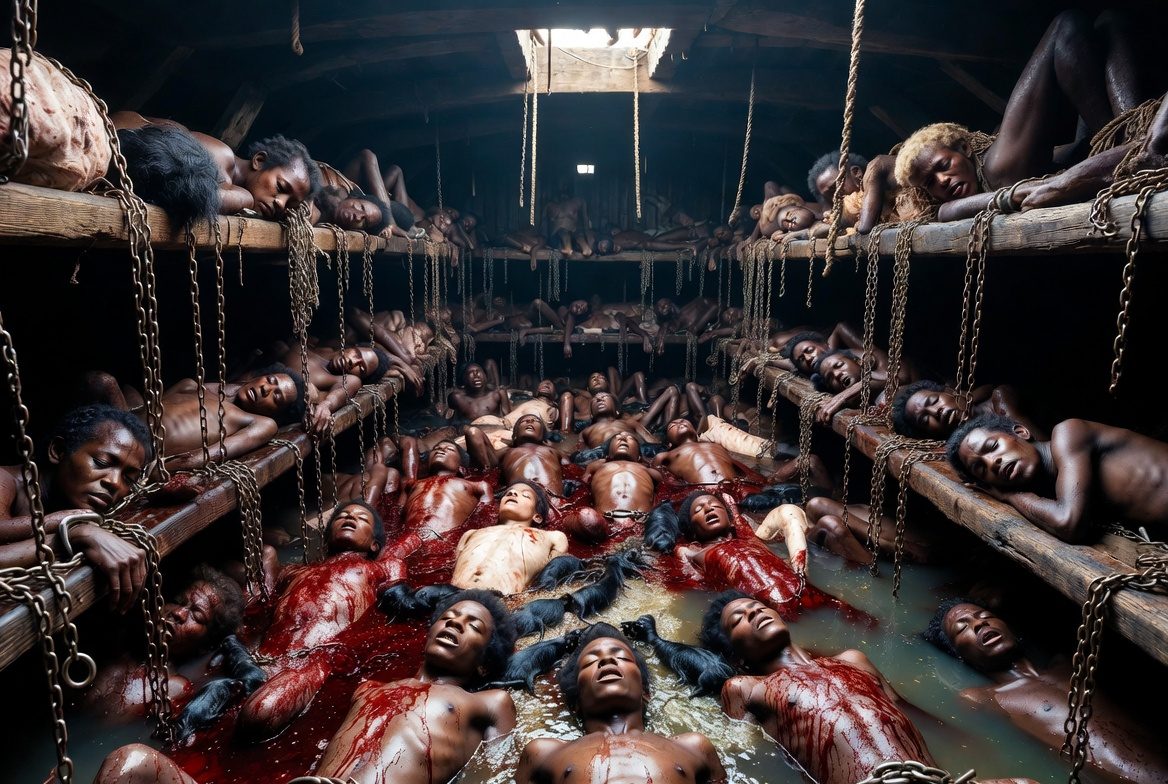
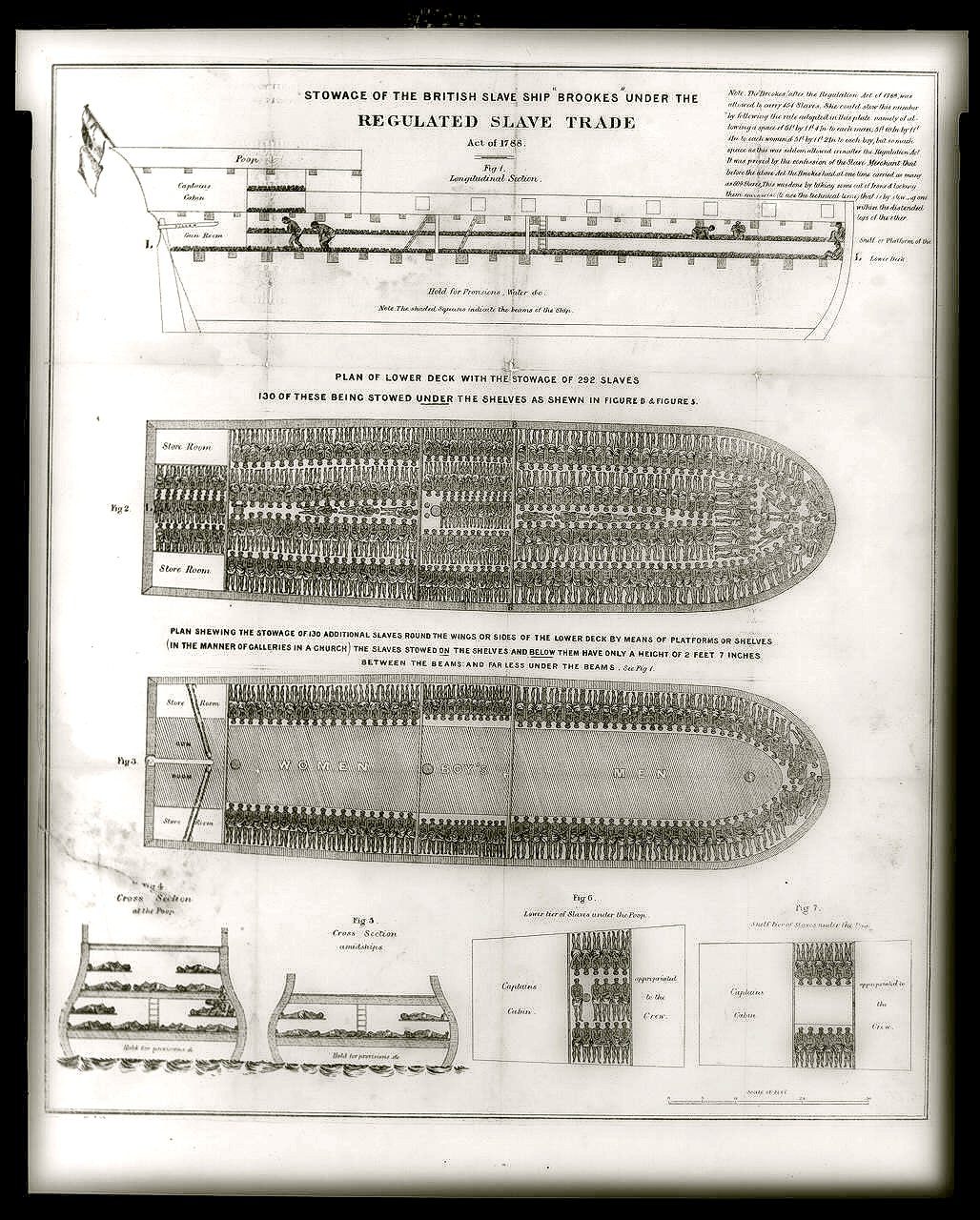
Enslaved Africans stacked on wooden shelves inside a slave ship hold, men, women, and children crammed into tiered platforms with chains and no space to move.
Captives were stacked on wooden shelves with barely 18 inches of headroom. The dead were left among the living for hours. In the infamous Zong massacre of 1781, 132 enslaved people were thrown overboard alive so the ship's owners could file an insurance claim on “lost cargo.”
Stage 6

Arrival in the New World, First Steps on Foreign Soil

Those who survived the voyage faced immediate sale. Many were too ill to stand. This was the gateway to lifelong bondage.

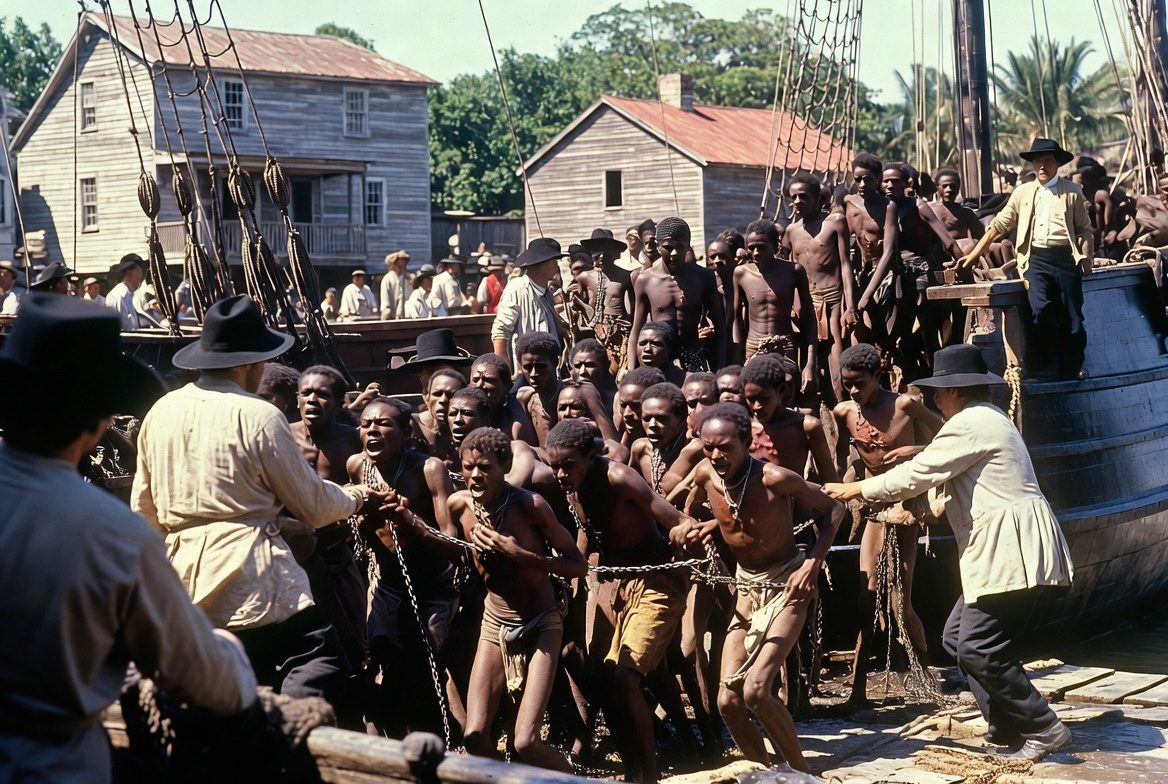
Enslaved Africans being unloaded from a slave ship at a colonial port, chained captives herded onto the docks by European traders as onlookers gather.
After months at sea, survivors were dragged from the ship's hold into blinding daylight. Weak, disoriented, and ill, they were hosed down, oiled, and prepared for inspection, their humanity reduced to marketable condition.
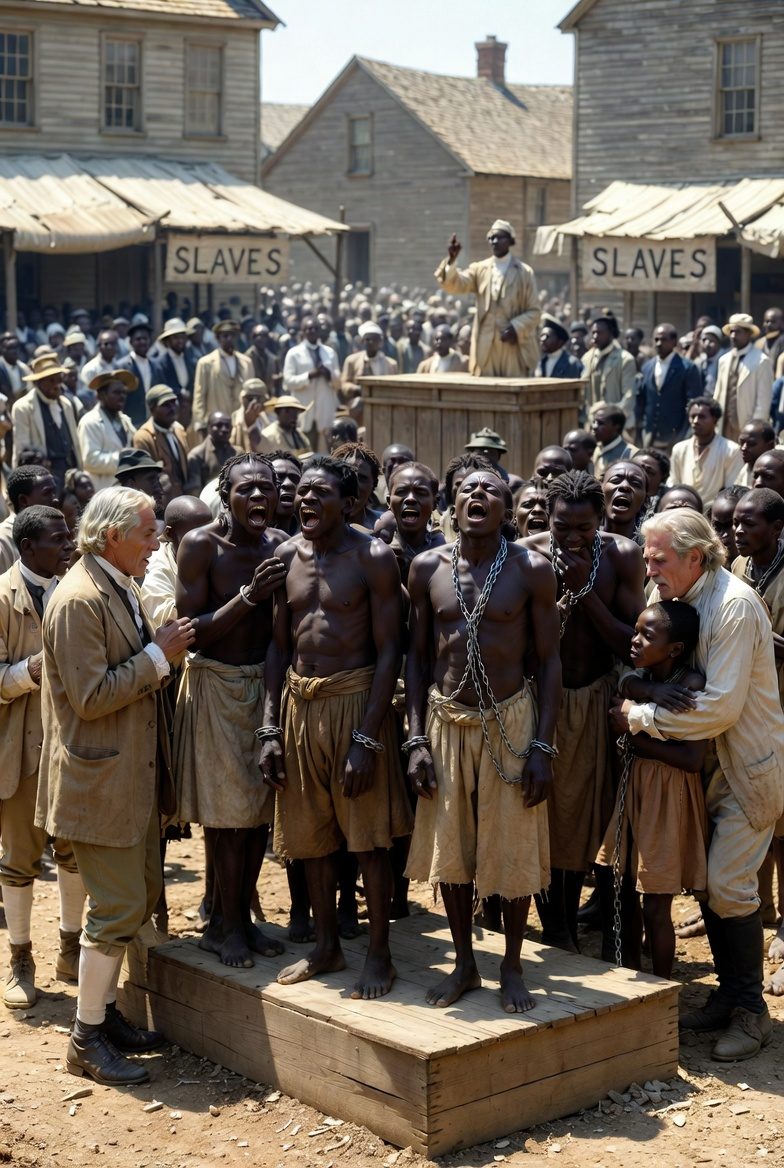
Enslaved Africans standing on an auction block in chains while white slaveholders inspect and bid on them at a public slave market.
On the auction block, families were torn apart as men, women, and children were sold separately to the highest bidder. Names were erased, languages forbidden, and identities stripped, the final act before a lifetime of forced labor.
The Routes

Mapping the Maafa

Historical maps documenting the forced transportation routes of enslaved Africans across the Atlantic and beyond. Each line represents thousands of lives torn from their homeland.

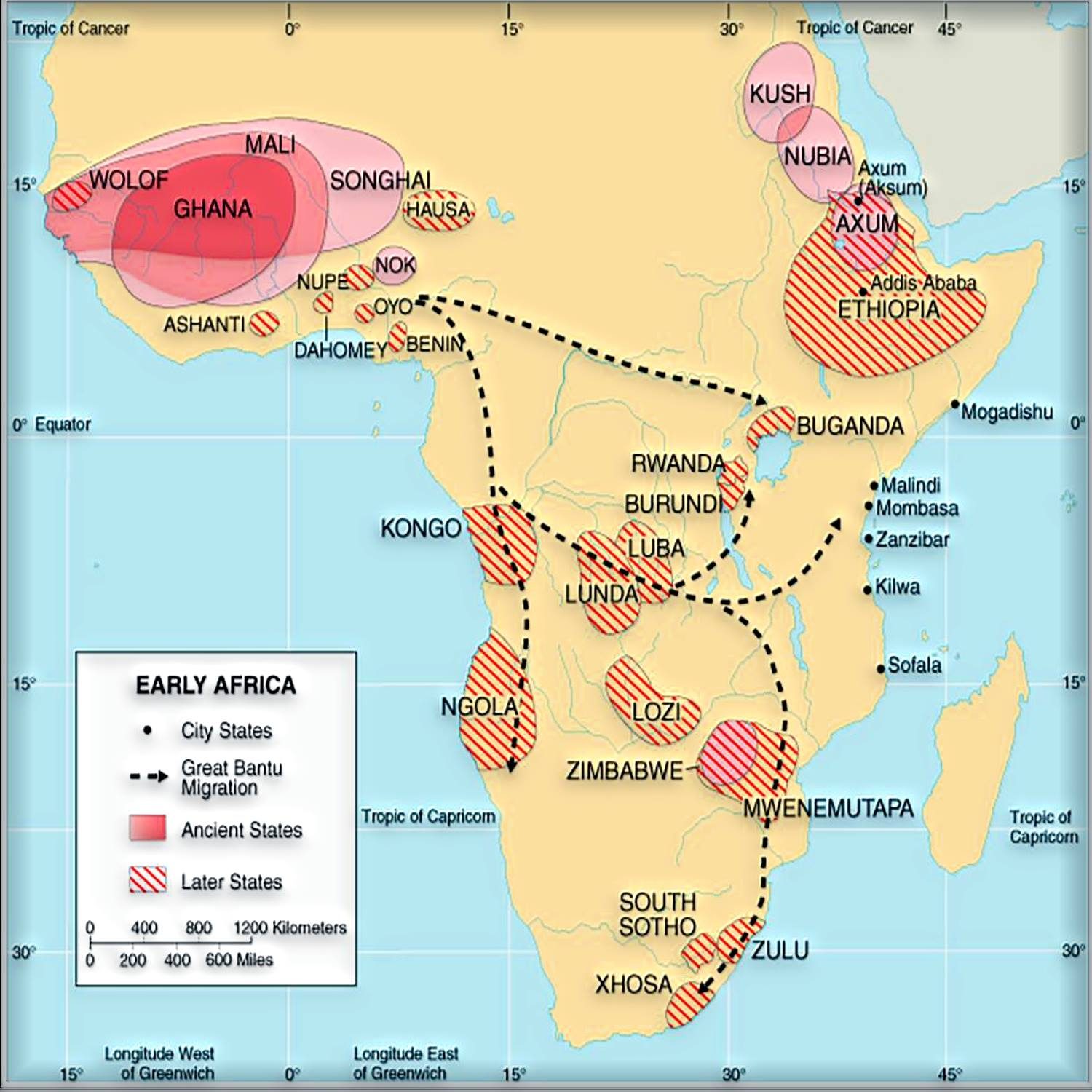
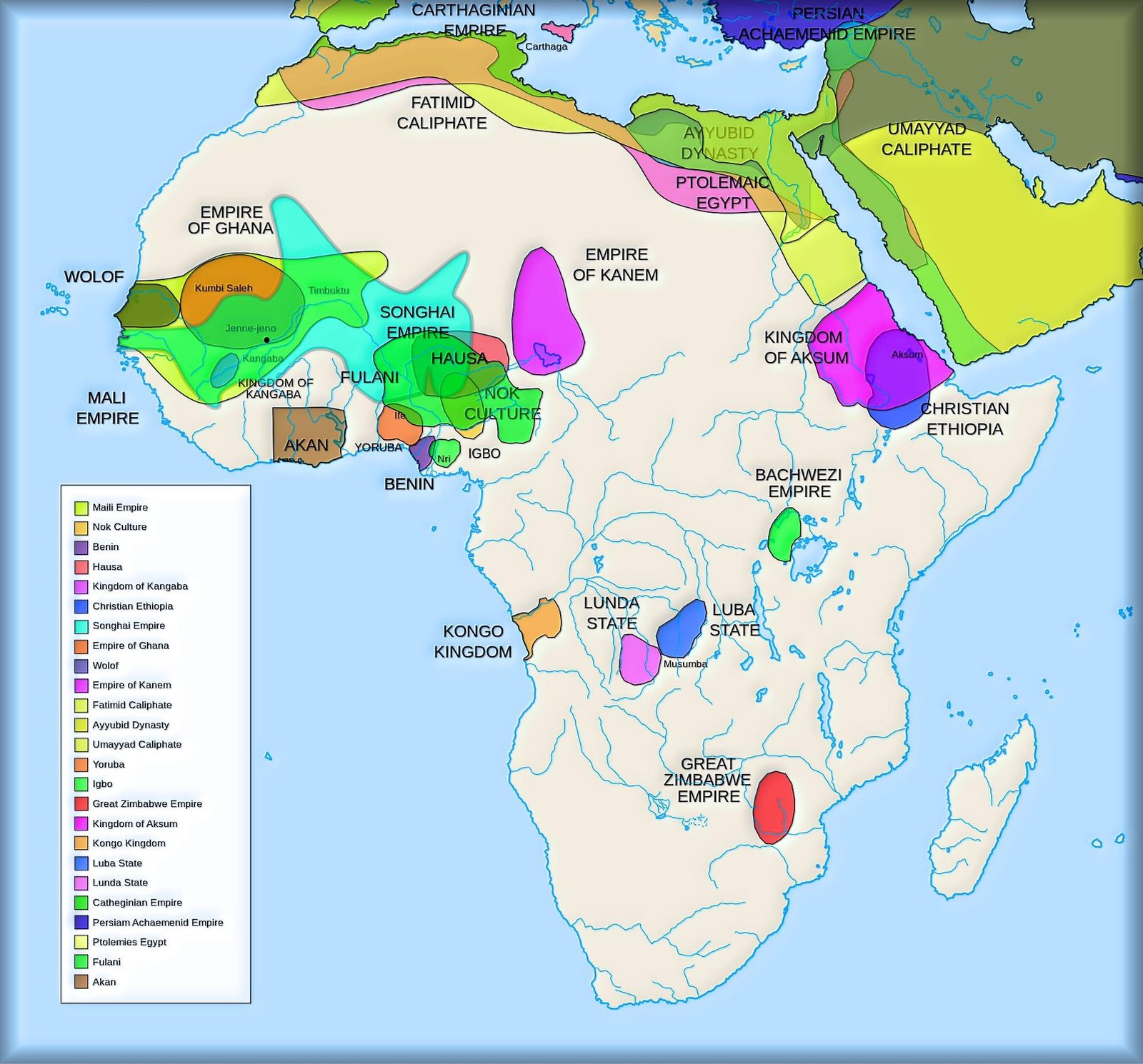
Map of Early Africa showing ancient and later states including Mali, Ghana, Songhai, Kush, Nubia, Axum, Zimbabwe, and the Great Bantu Migration routes
Early Africa, Ancient states, city-states, and the Great Bantu Migration
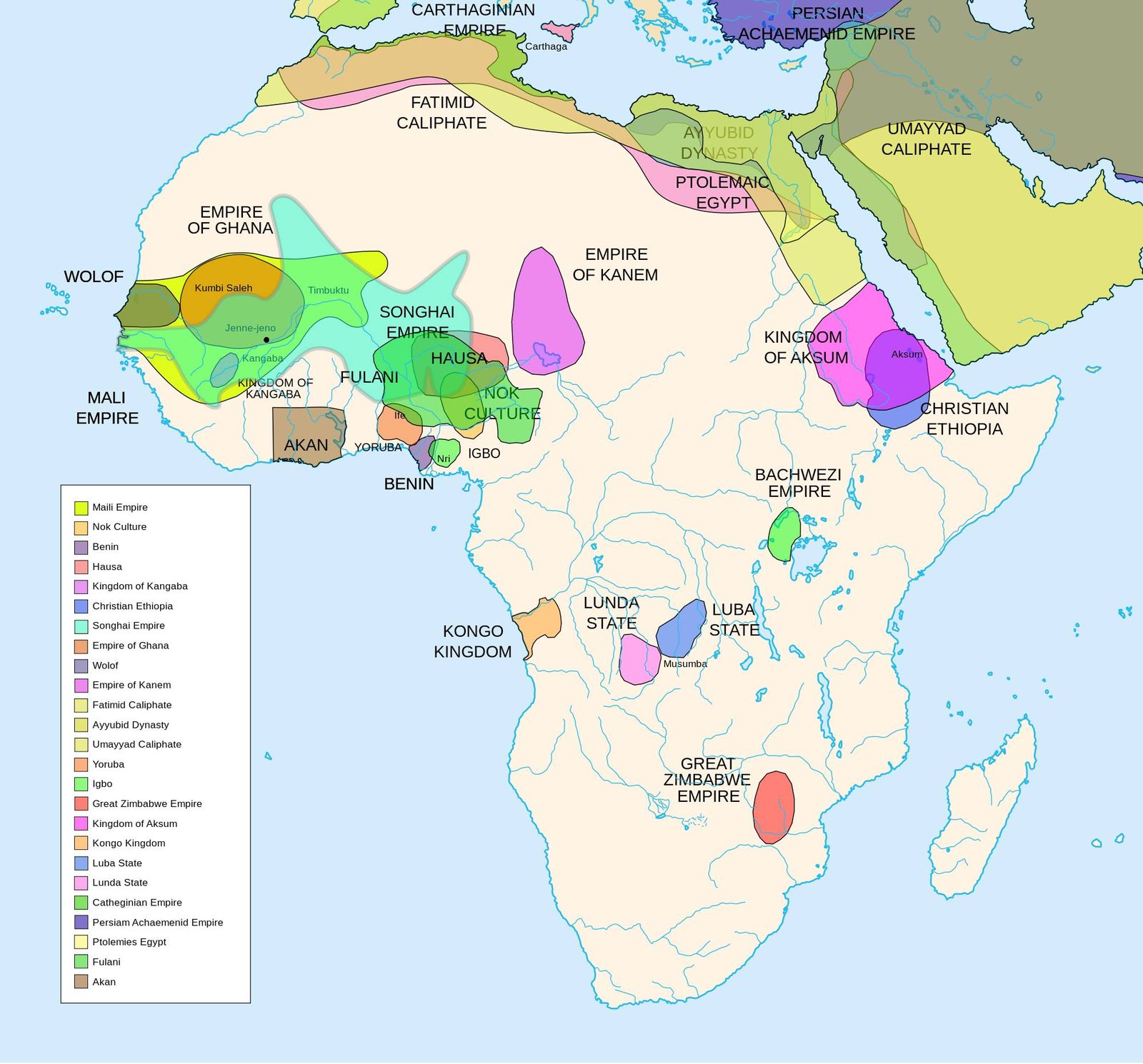
Map of pre-colonial African empires and kingdoms including Mali, Songhai, Ghana, Hausa, Yoruba, Kongo, and other kingdoms
Pre-Colonial African Empires and Kingdoms
Detailed map of African empires and civilizations showing territorial extent of Mali, Songhai, Ghana, Hausa, Yoruba, Kongo, and other kingdoms
African Empires and Civilizations, Territorial extent
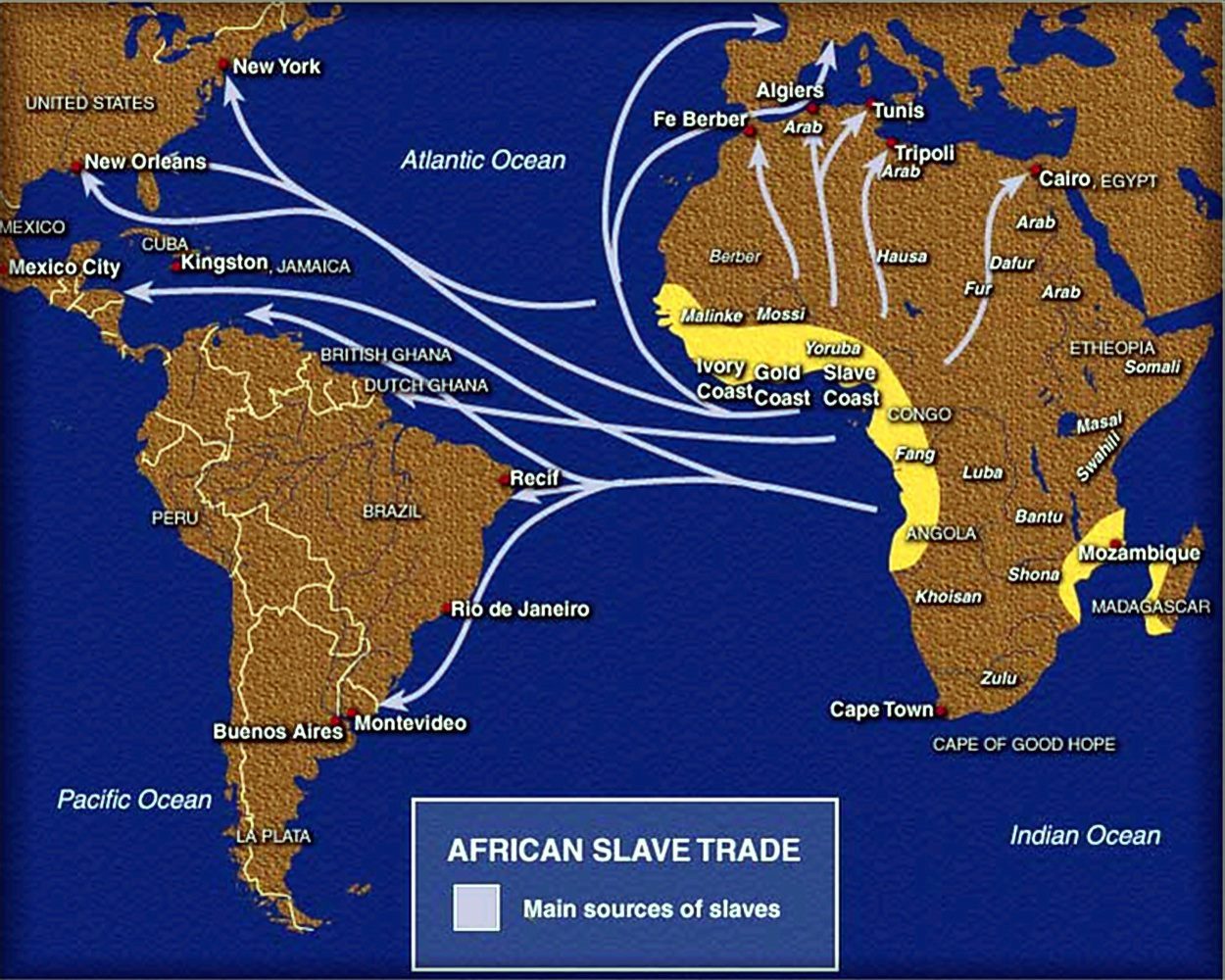
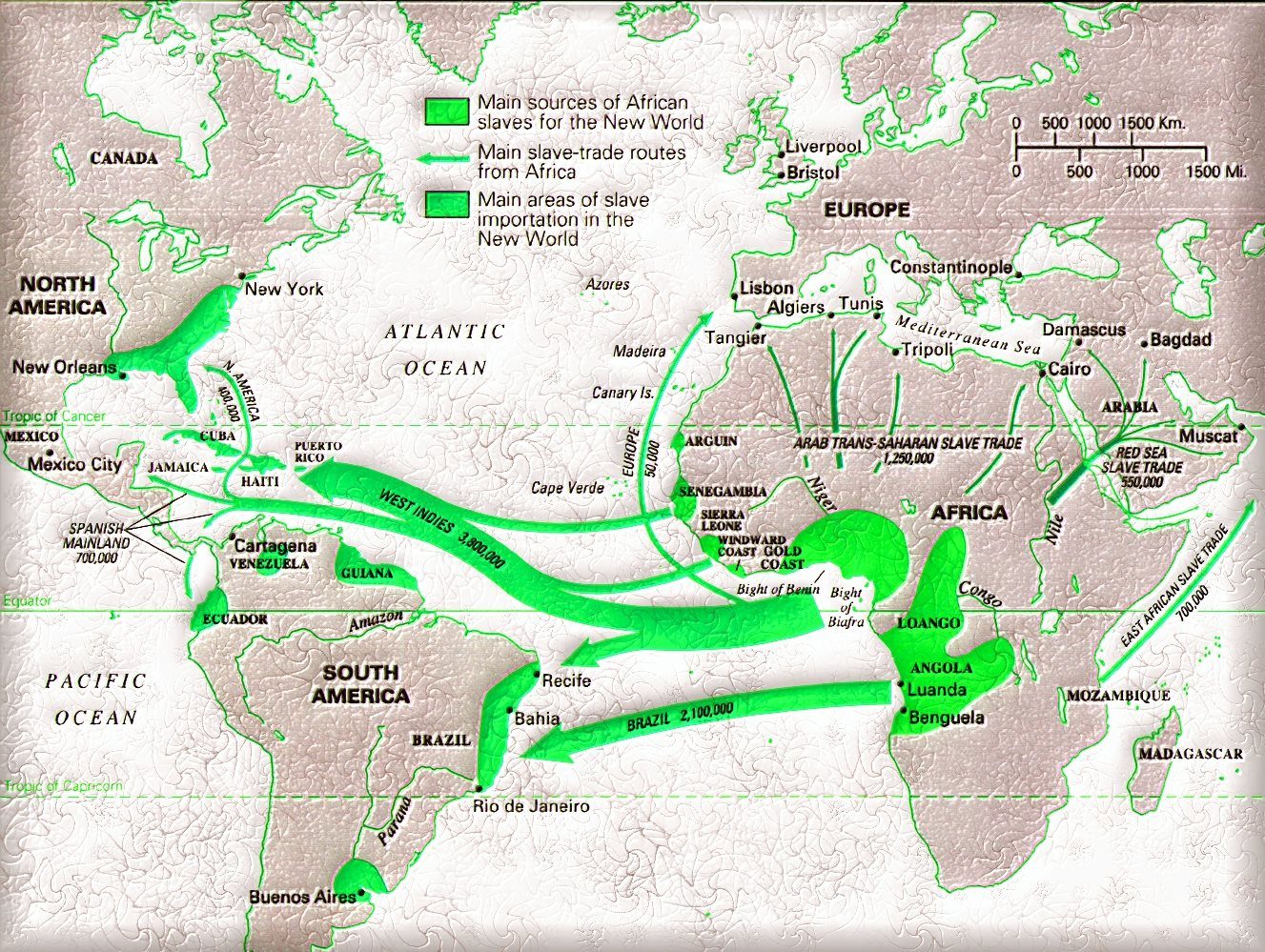
Map showing main African slave trade routes across the Atlantic Ocean
African Slave Trade, Main sources and transatlantic routes
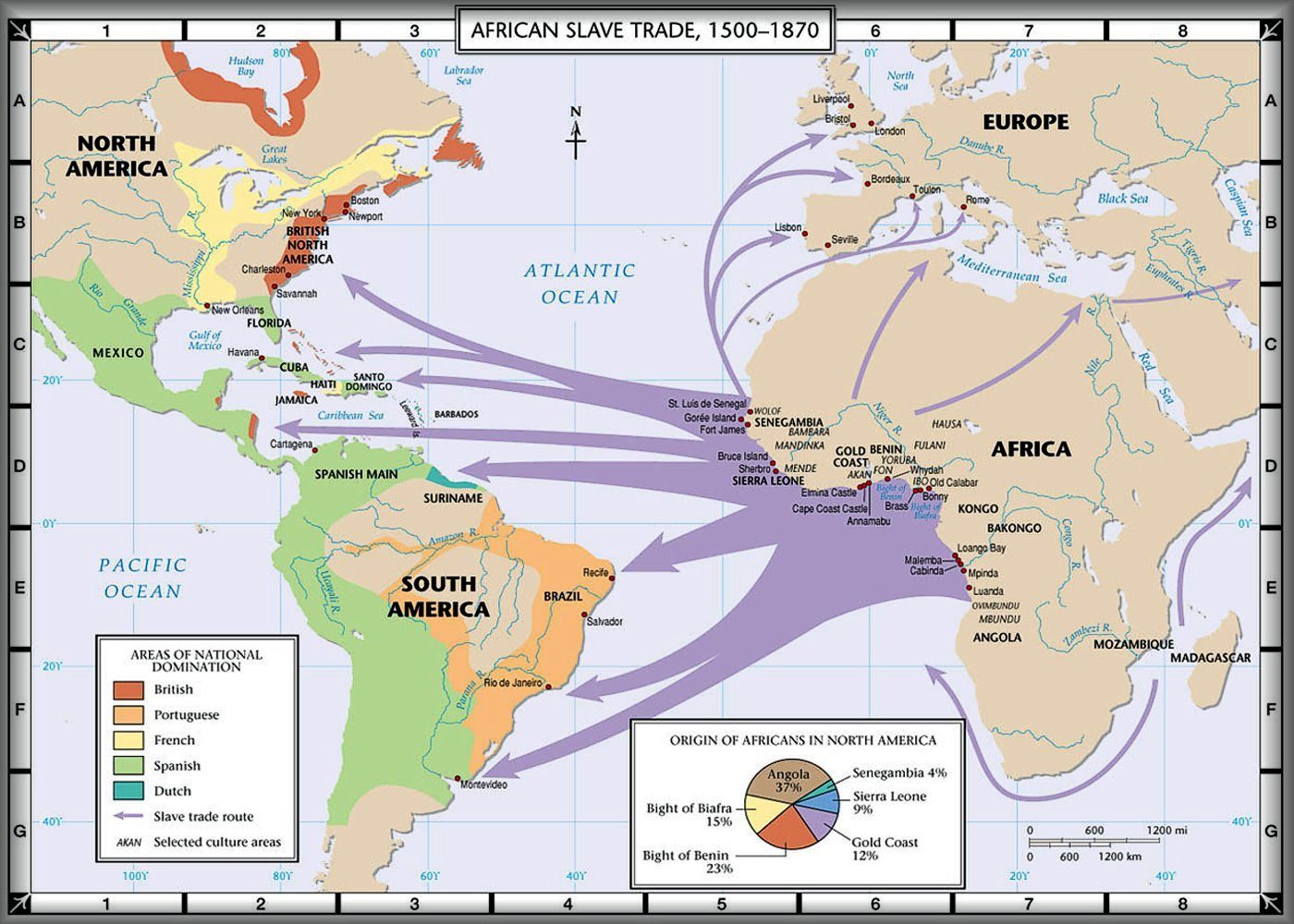
Detailed historical map of the African slave trade from 1500 to 1870, showing areas of national domination
African Slave Trade, 1500–1870, Colonial domination and trade routes
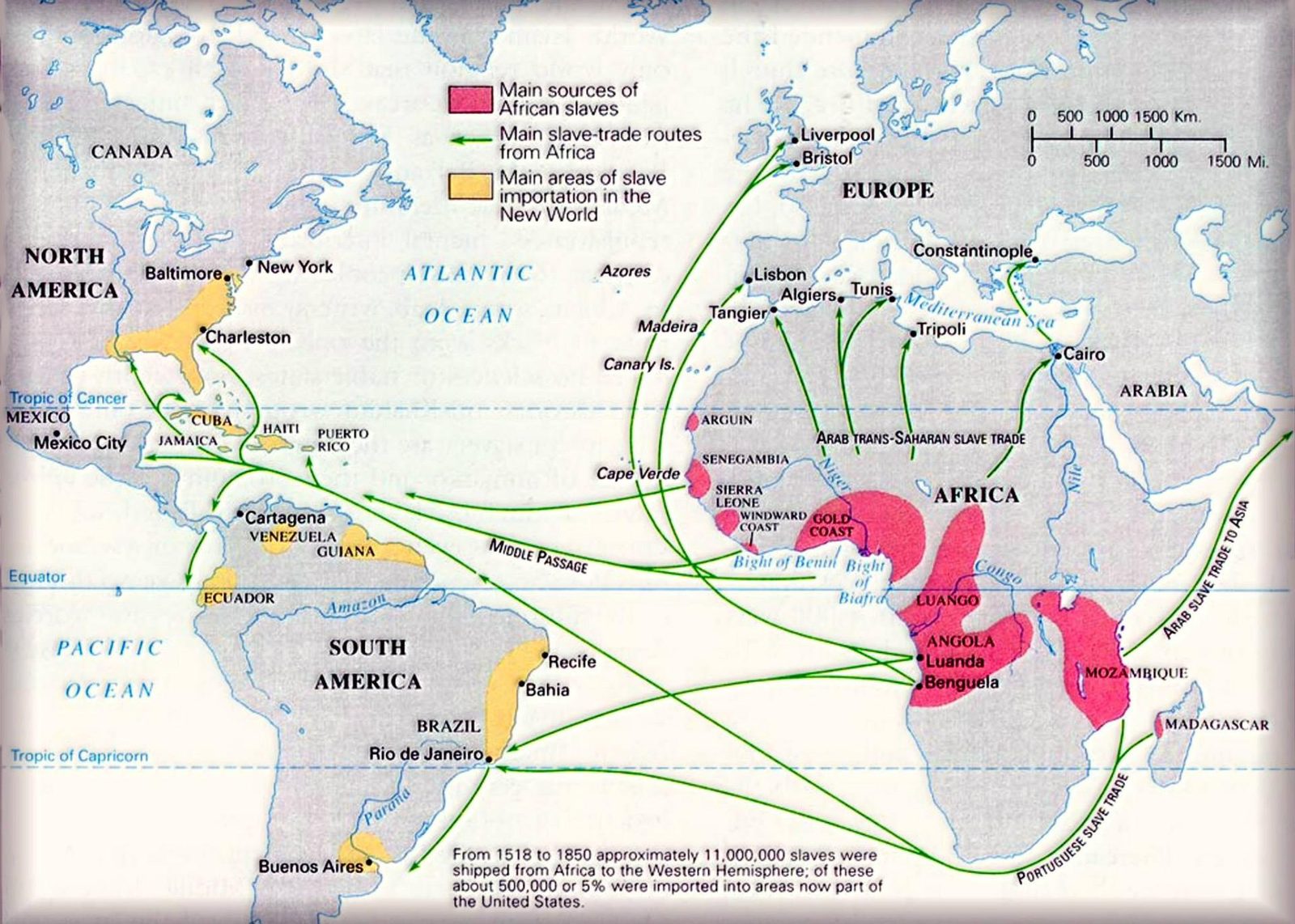
Map showing main slave-trade routes from Africa with source regions highlighted in pink and destination ports labeled
Slave Trade Routes, Main sources, Middle Passage, and Arab trans-Saharan trade
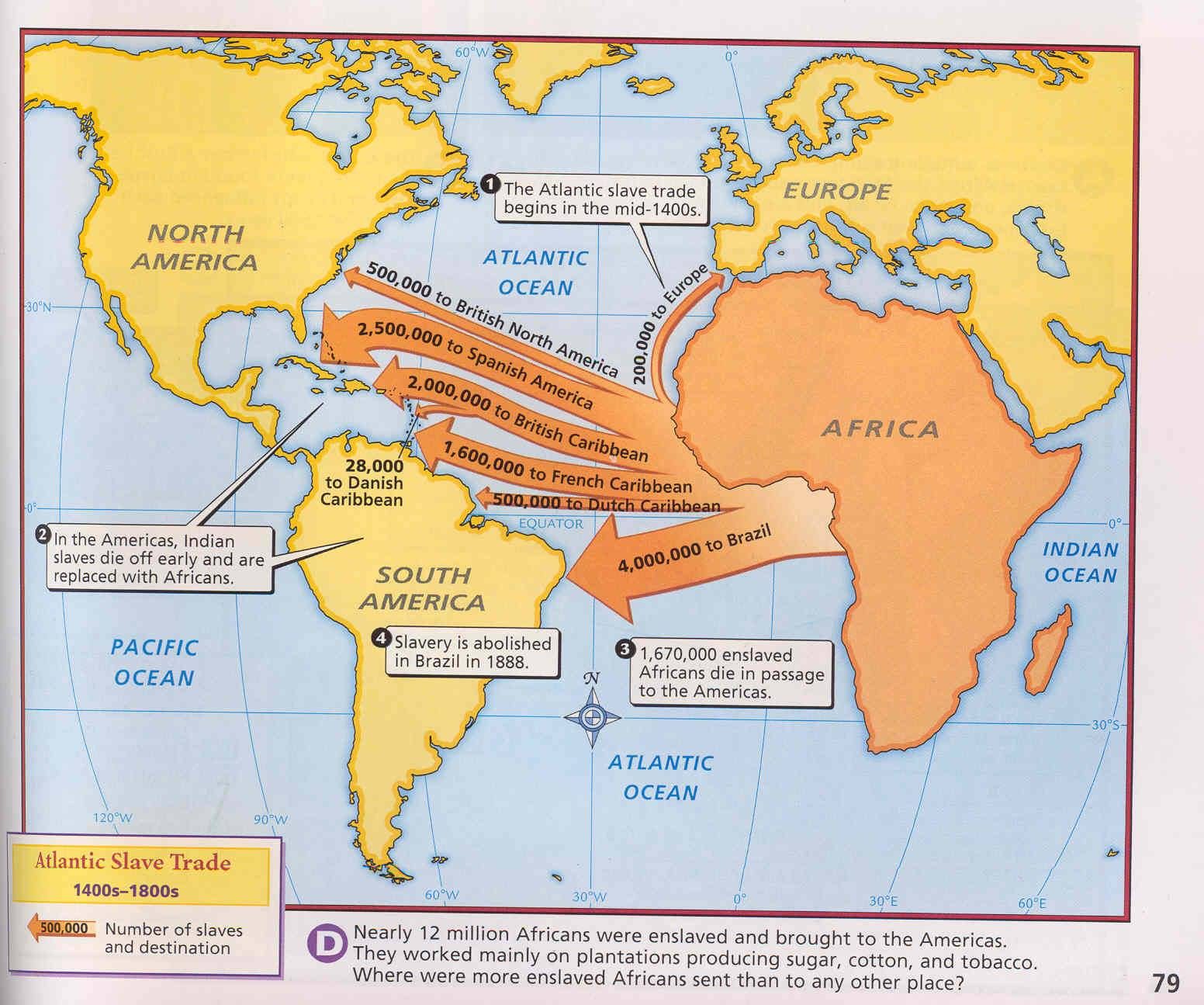
Atlantic Slave Trade map from 1400s-1800s showing number of enslaved Africans sent to each destination region
Atlantic Slave Trade, 1400s–1800s, Numbers by destination
Map showing main sources of enslaved Africans and slave-trade routes with volume estimates for each region
Main Sources and Routes, Volume estimates by region
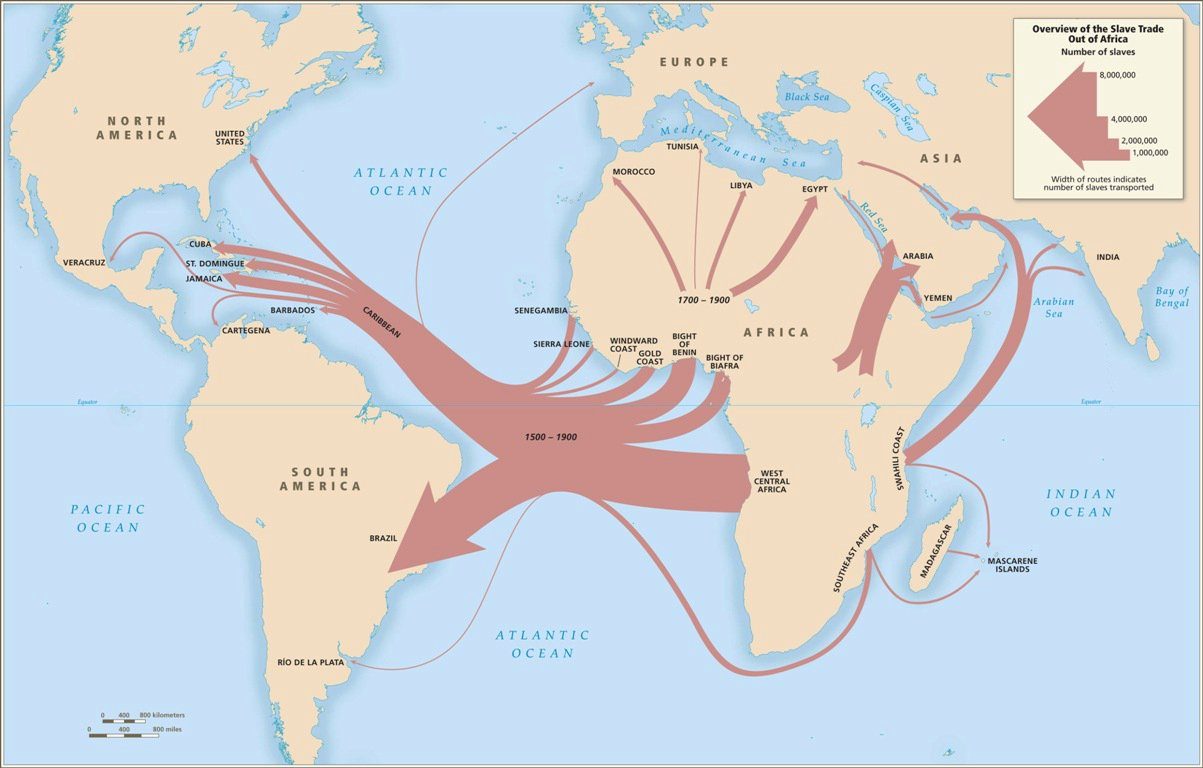
Overview of the Slave Trade out of Africa showing routes to the Americas, Europe, and Asia with arrow widths proportional to number of slaves transported
Overview of the Slave Trade Out of Africa, Routes and volume by destination
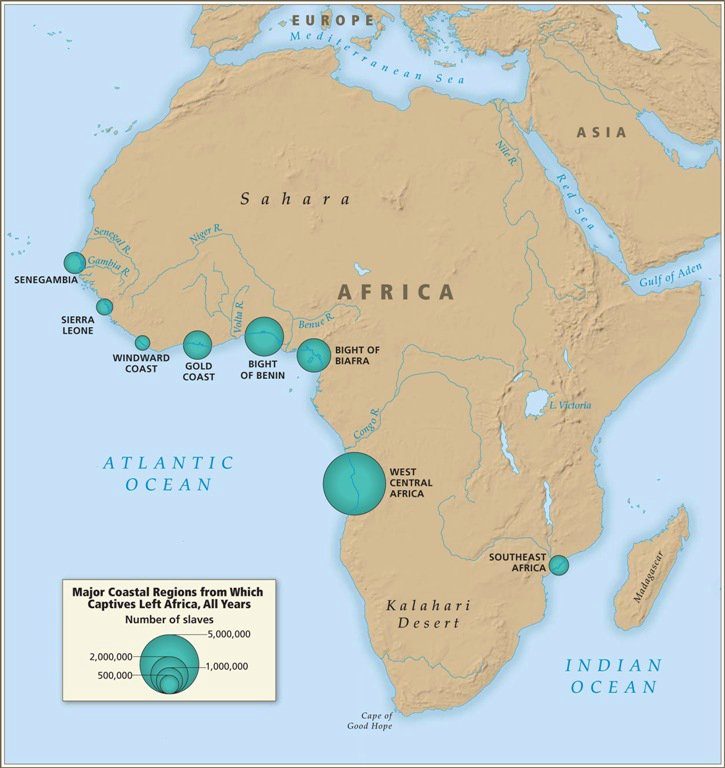
Major coastal regions from which captives left Africa, showing proportional circles for Senegambia, Sierra Leone, Windward Coast, Gold Coast, Bight of Benin, Bight of Biafra, West Central Africa, and Southeast Africa
Major Coastal Regions of Captive Embarkation, All years
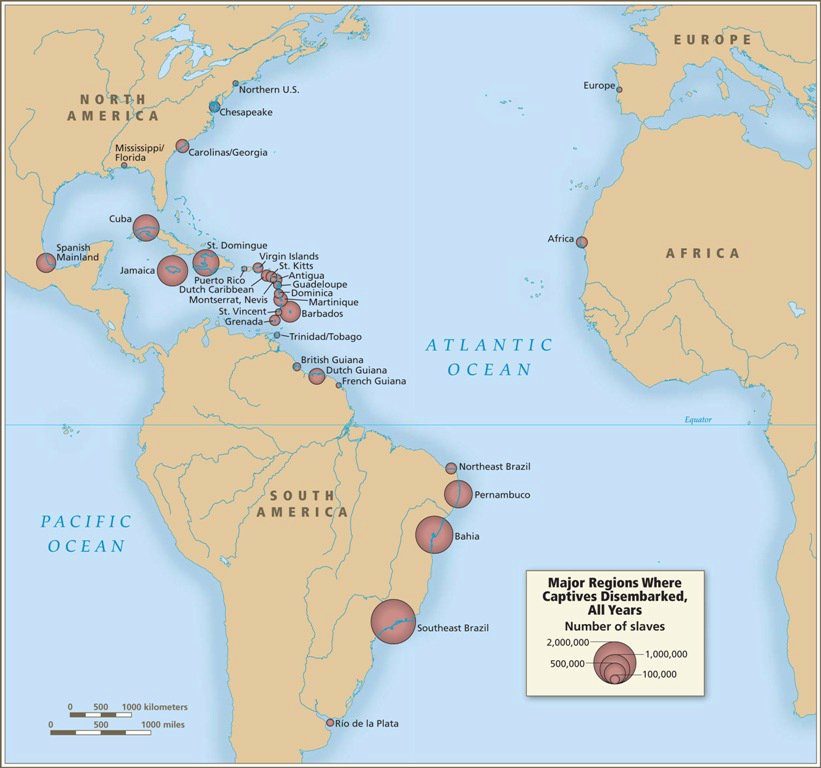
Major regions where captives disembarked in the Americas, showing proportional circles for Southeast Brazil, Bahia, Caribbean islands, Chesapeake, and other destinations
Major Regions of Captive Disembarkation, All years
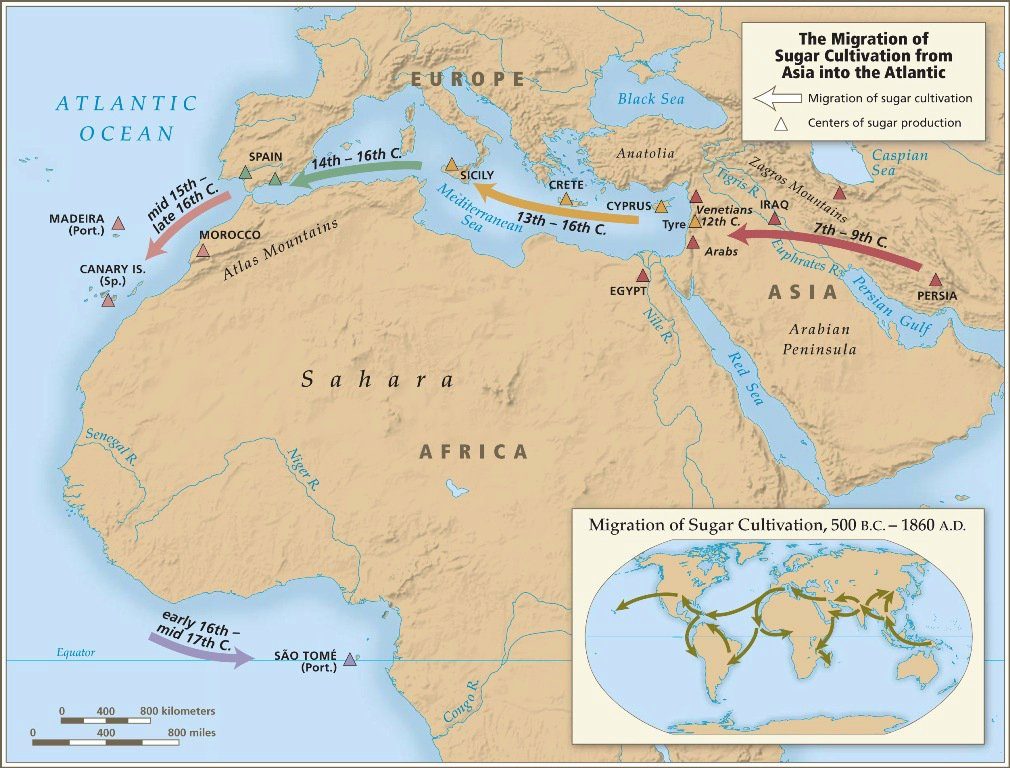
Migration of sugar cultivation from Asia into the Atlantic, 500 BC to 1860 AD, showing how sugar drove the demand for enslaved labor
Migration of Sugar Cultivation, 500 B.C.–1860 A.D., The crop that fueled the trade
Diagram of the British slave ship Brookes showing the regulated stowage of 292 enslaved Africans under the Regulated Slave Trade Act of 1788
Slave Ship Brookes, Regulated stowage diagram under the Slave Trade Act of 1788
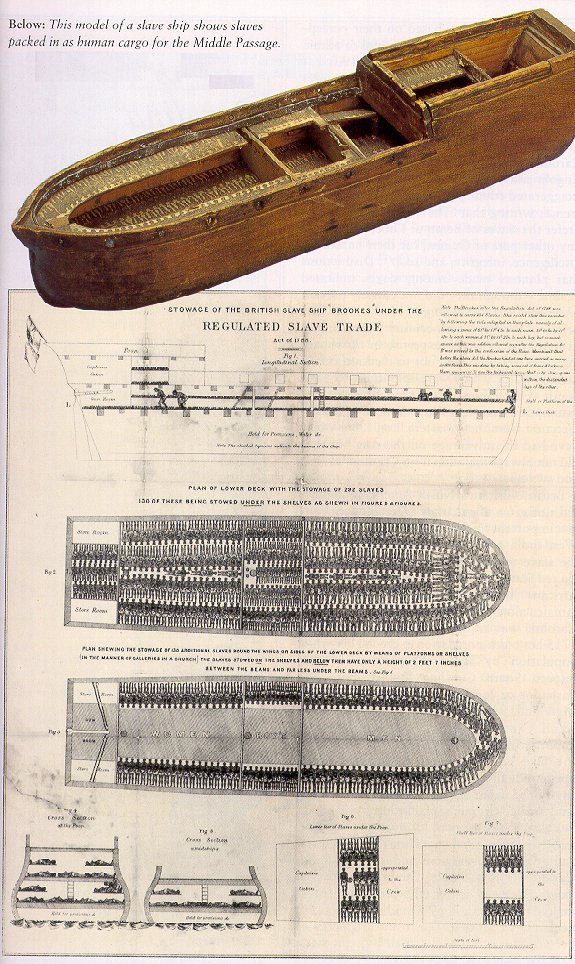
Model of a slave ship alongside the Brookes diagram, showing how enslaved Africans were packed as human cargo for the Middle Passage
Slave Ship Model and Brookes Plan, Human cargo of the Middle Passage
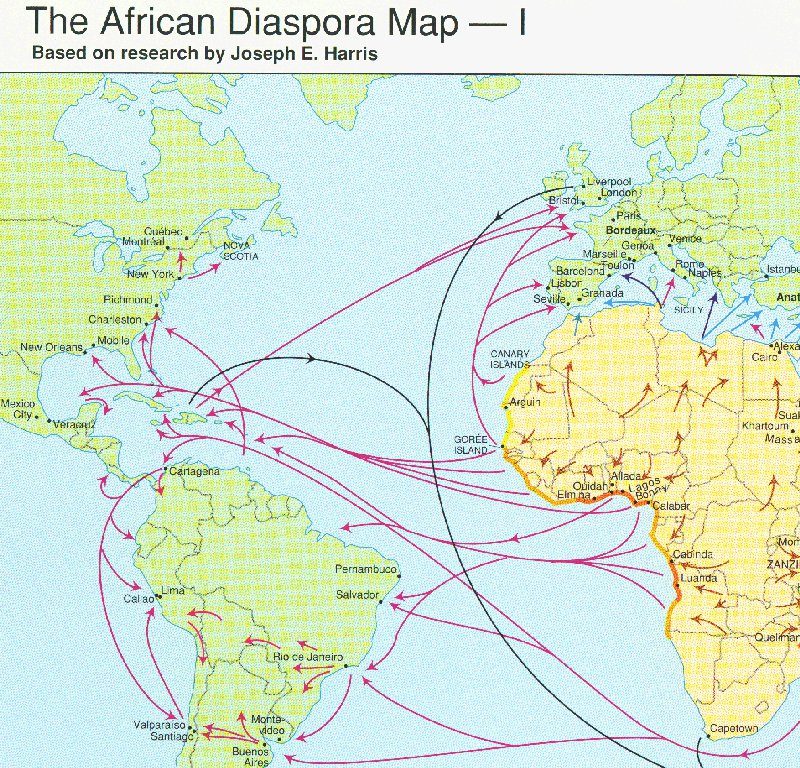
The African Diaspora Map showing westward forced migration routes
The African Diaspora Map I, Western routes (Joseph E. Harris)
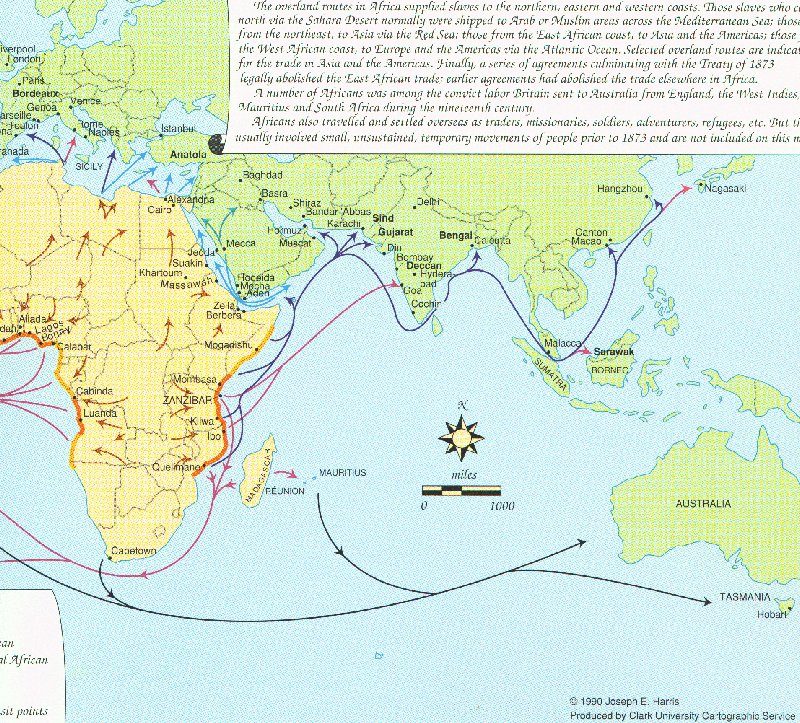
The African Diaspora Map showing eastward forced migration routes to Asia and Australasia
The African Diaspora Map II, Eastern routes (Joseph E. Harris)
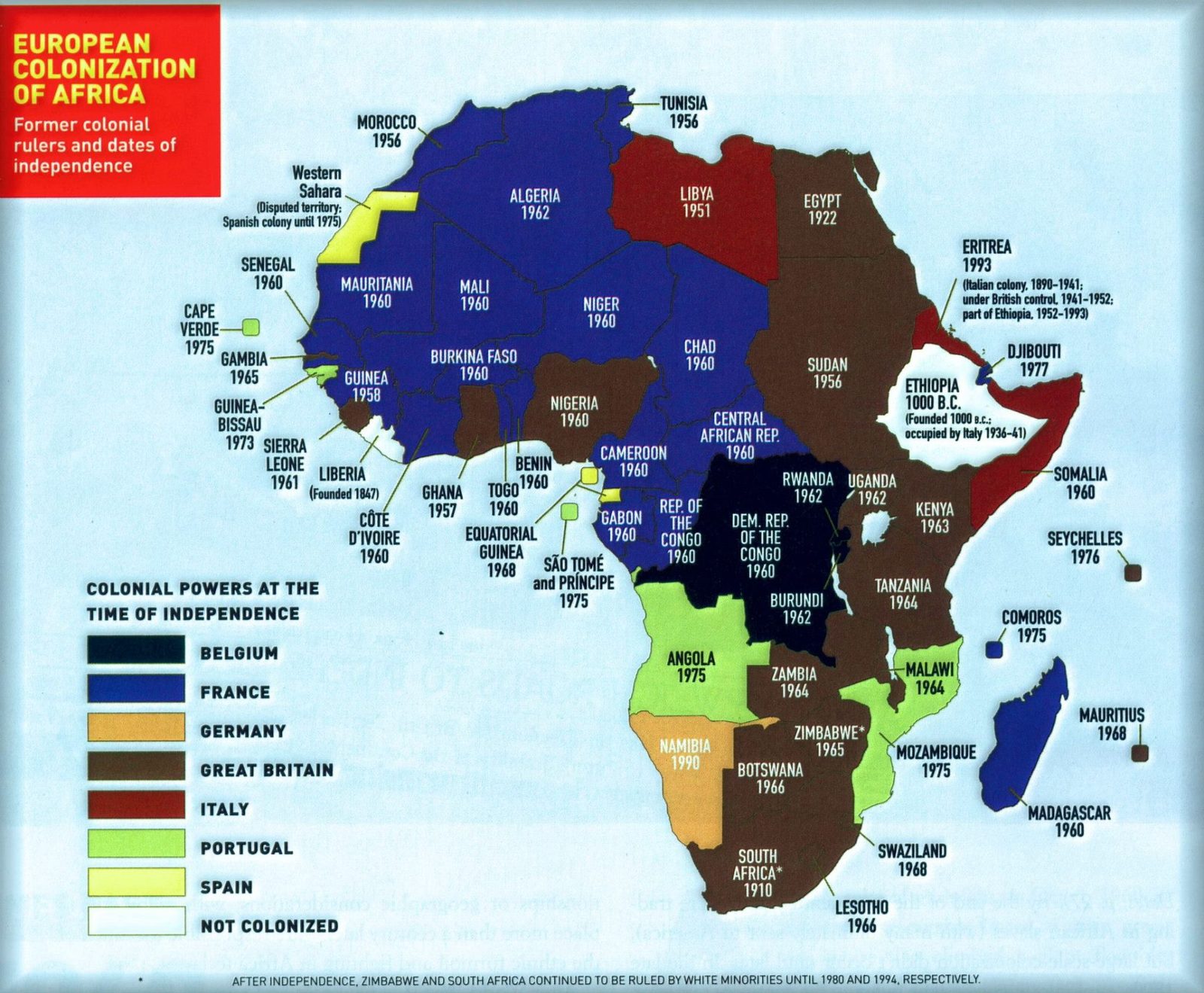
Map of European colonization of Africa showing former colonial rulers by color and dates of independence for each nation
European Colonization of Africa, Colonial powers and dates of independence
II. The Financial Architecture

How the World's Wealthiest Institutions Were Built

The transatlantic slave trade was the most profitable enterprise of the early modern era. It was backed by leading financial institutions, approved by governments, justified by religious authorities, and protected by navies.

Enslaved Africans and the commodities they produced, sugar, cotton, tobacco, rice, indigo, generated the capital that fueled the Industrial Revolution and helped build the banking systems of London, Amsterdam, Lisbon, Paris, New York, and beyond.

States like Britain, Portugal, and Spain granted monopoly charters to companies whose explicit business included organizing slaving voyages, maintaining forts on the African coast, and supplying enslaved Africans to plantations. Banks and insurers financed ships, plantations, and colonial governments. They took enslaved people and slave-produced commodities as collateral. They insured slave ships and enslaved lives against 'loss.'

When slavery was finally abolished in different empires, European states compensated the slave owners, not the enslaved. In Britain, the government paid £20 million in 1833 (equivalent to roughly £17 billion today) to slaveholders. The formerly enslaved received nothing. Some of that compensation capital fed directly into banks and businesses that still operate today.

In Haiti, after the only successful large-scale slave revolt overthrew colonial rule in 1804, France forced the new Black republic to pay a massive indemnity to former slaveholders for the 'loss' of their human property. Haiti did not finish repaying this imposed debt until the mid-20th century.

III. The Institutional Ledger

Naming the Conspirators and Beneficiaries

The following is a nation-by-nation accounting of the companies, banks, insurers, and institutions that organized, financed, insured, or profited from the transatlantic slave trade. Entities marked with ★ still operate today.

Sources include: UCL Legacies of British Slave-ownership database, Bank of England museum archives, De Nederlandsche Bank commissioned reports, ABN AMRO commissioned studies, Ethical Consumer research, Slave Voyages database, and the institutions' own published acknowledgments.

Britain

26.1%
~3.3 million Africans embarked

Portugal & Brazil

46.7%
~5.8 million Africans embarked

Spain

8.5%
~1.1 million Africans embarked

France

11%
~1.4 million Africans embarked

The Netherlands

4.8%
~600,000 Africans embarked

Denmark-Norway

0.5%
~120,000 Africans embarked

Sweden

Brandenburg-Prussia (German States)

United States

2.4%
~estimated direct trade Africans embarked
IV. The System

Recurring Patterns Across All Empires

Across all participating empires, historians identify recurring categories of complicit institutions:

State-chartered trading companies with explicit slave-trade monopolies, the Royal African Company, South Sea Company, Dutch West India Company, Companhia Geral do Grão-Pará e Maranhão, Danish West India-Guinea Company, Compañía Gaditana de Negros, and others.

Central banks or proto-central banks whose founders or early capital providers were plantation owners, slave traders, or slave insurers, the Bank of England, De Nederlandsche Bank, Banco do Brasil.

Commercial banks whose predecessor partnerships owned enslaved people, financed plantations, or invested in slave economies, often receiving compensation upon abolition, Barclays, Lloyds Banking Group, HSBC, NatWest/RBS, ABN AMRO, J.P. Morgan Chase, and others.

Insurance markets and companies that insured slave ships, enslaved lives, and slave-based cargoes, Lloyd's of London, Dutch insurance companies in Middelburg and Amsterdam, New York Life, Aetna, and others.

Institutions with Documented Slavery Links, Operating Today

Bank of EnglandBritainCentral bank, slave-trader shareholders
BarclaysBritainPredecessor slave-owner compensation
Lloyds Banking GroupBritainPredecessor abolition compensation
HSBCBritainPredecessor slavery investments
NatWest/RBSBritainPredecessor abolition compensation
Lloyd's of LondonBritainInsured slave ships and cargo
RSA InsuranceBritainSlave-owner compensation links
Greene KingBritainSlave-owner descendant company
Banco do BrasilBrazilTaxed slave ships, credited traders
ABN AMRONetherlandsPredecessor plantation finance
De Nederlandsche BankNetherlandsStart-up capital from slavery
J.P. Morgan ChaseUSAPredecessor accepted enslaved as collateral
New York LifeUSAInsured enslaved people's lives
Wells Fargo (Wachovia)USAPredecessor owned enslaved people
AetnaUSAInsured enslaved people's lives

This list is not exhaustive. Archival and scholarly work continues to uncover additional connections. AHF will update this page as new research emerges.

V. The Present

The Wound That Did Not Heal

Legal abolition did not end the underlying system. It changed its forms.

In the United States, slavery was followed by Black Codes, convict leasing, sharecropping, racial massacres, segregation, lynching, redlining, exclusion from benefits like the GI Bill and Social Security, discriminatory policing, the 'War on Drugs,' and mass incarceration. Each of these reproduced old hierarchies under new names.

Science now confirms what descendants have long felt: the trauma lives on in bodies and minds. Extreme trauma can leave epigenetic marks, changes in how genes are expressed, that are passed from parents to children. For descendants of enslaved Africans, centuries of slavery, sexual violence, family separation, structural racism, and chronic threat have produced a measurable health deficit: elevated rates of heart disease, hypertension, diabetes, and early mortality that cannot be explained by income alone. This is not the biology of 'race.' It is the biology of long-term oppression.

Dr. Joy DeGruy's groundbreaking framework of Post-Traumatic Slave Syndrome (PTSS) identifies the multigenerational behavioral patterns, damaged self-esteem, ever-present anger, and racist socialization, that result from centuries of chattel slavery and its aftermath. Crucially, these patterns cannot be healed only at the individual level. They require structural change.

The societies that built and defended slavery also carry a wound. When beneficiaries of inherited systems refuse to acknowledge the connection between historical exploitation and present inequality, they enter into moral injury and denial.
Sources & Further Research

The Ledger Is Open

VOYAGE DATABASE

Trans-Atlantic Slave Trade Database

Over 36,000 documented voyages. Searchable by ship, date, origin, destination, captain, and number of enslaved. The most detailed quantitative record of the Maafa in existence.

Visit slavevoyages.org →
COMPENSATION DATABASE

UCL Legacies of British Slave-ownership

Database of British slave owners and the £20 million compensation they received upon abolition, paid to slaveholders, not the enslaved. Traces names, amounts, and modern institutional connections.

Explore database →
CENTRAL BANK REPORT

Bank of England: Slavery and the Bank

The Bank of England's own exhibition documenting the connections between its founding shareholders, directors, and the slave trade.

Visit exhibition →
CENTRAL BANK REPORT

De Nederlandsche Bank: Serving the Chain

DNB's commissioned report documenting how the Dutch central bank's start-up capital included investors with direct plantation slavery interests.

Read report (PDF) →
COMMISSIONED STUDY

ABN AMRO Slavery Report (IISG)

Independent study finding that predecessor firms had slavery-related operations at the core of their business, including plantation finance and slave-commodity trading.

Read report (PDF) →
PEOPLE DATABASE

Enslaved.org

A linked open data project connecting disparate archives about individuals who were enslaved, owned enslaved people, or participated in the trade.

Visit enslaved.org →
CORPORATE RESEARCH

Ethical Consumer: Banks and Slavery

Research identifying UK banks with historical links to the slave trade, including Barclays, Lloyds, HSBC, NatWest/RBS, and others.

Read research →
INSURANCE HISTORY

Lloyd's of London: Trans-Atlantic Slave Trade

Lloyd's own published acknowledgment of its marketplace's historical role in insuring slave ships and slave-related commerce.

Read at lloyds.com →
SCHOLARLY COLLECTION

UNESCO General History of Africa

Eight volumes documenting African history from a pan-African perspective. The most comprehensive scholarly account ever compiled. Free PDF access.

Download at Internet Archive →
REPARATIONS FRAMEWORK

CARICOM Reparations Commission

The Caribbean Community's formal reparations program with a Ten-Point Plan for reparatory justice from former colonial powers.

Visit caricomreparations.org →
ECONOMIC ANALYSIS

Brattle Group: Quantification of Reparations

Economic analysis quantifying the value of the transatlantic slave trade at $100–131 trillion in present-day terms.

Read report (PDF) →
DOCUMENTARY

Africa's Great Civilizations (PBS)

Six-part series by Henry Louis Gates Jr. spanning 200,000 years of African history, including the slave trade and its institutional perpetrators.

Watch on PBS →
"The past cannot be undone. But the present can be stabilized, and the future can be healed. The evidence is clear. The path is visible. The choice belongs to this generation."
The Healing of the Human Family
The Interruption Thesis

The Maafa Did Not Find a Weak Africa. It Found a Flourishing One, and Dismantled It.

At the moment the European transatlantic slave trade began, African civilizations were among the most sophisticated on Earth. The University of Sankore in Timbuktu held 25,000 students and housed over one million manuscripts. The Yoruba city of Ile-Ife had sewerage systems more advanced than contemporaneous European cities. The Kingdom of Kongo maintained a postal system, a legal code, and diplomatic relations with Portugal as a peer nation. The Kingdom of Benin's bronze-casting was unmatched in technical precision anywhere on the planet.

The Maafa did not find a pre-civilizational Africa. It found a continent of 400+ distinct civilizations, and systematically dismantled the most productive of them over 400 years, routing their human capital, their intellectual labor, and their physical bodies into the engine of European industrial capitalism. What was interrupted was not merely African progress, it was a contribution to human civilization that the entire world has been denied.

"The science not invented. The art not created. The medicine not developed. The philosophy not written. The governance not evolved. AHF names this the greatest unacknowledged intellectual and human capital loss in recorded history, and the primary reason why reparatory justice is not charity. It is civilizational debt repayment."
12.5, 13M
AFRICAN HUMAN BEINGS TAKEN

Each one a person with a name, a family, a cosmology, a future.

2+ Million
DIED IN THE MIDDLE PASSAGE

Thrown overboard. Killed by disease, despair, and deliberate murder during the ocean crossing.

400 Years
DURATION OF THE EUROPEAN SLAVE TRADE

1441 to 1867. Four centuries of compounding civilizational damage to Africa and its diaspora.

7.8×
RACIAL WEALTH GAP TODAY (USA)

White families hold 7.8 times the median wealth of Black families, a direct documented consequence of the Maafa's living afterlives.

Chronological Evidentiary Record

From First Raid to Global Recognition, 1441 to 2026

Every date below is documented historical record.

  1. 1441

    First Portuguese Raids

    Portuguese sailors under Antão Gonçalves capture 12 Africans on the Mauritanian coast, the first documented act of the European transatlantic slave trade.

  2. 1502

    First Enslaved Africans in the Americas

    Spanish colonizers bring enslaved Africans to Hispaniola. The trade to the Western Hemisphere begins.

  3. 1619

    Arrival in English America

    The first documented enslaved Africans arrive in the English colony of Virginia. American chattel slavery begins its 246-year institutionalization.

  4. 1672

    Royal African Company

    The English crown charters the Royal African Company, granting monopoly rights to trade enslaved Africans. Its first governor: the future King James II. Its institutional successors still exist today.

  5. 1807

    British Abolition of the Slave Trade Act

    Britain bans the transatlantic transport of enslaved Africans, but not slavery itself. Slavery continues in British colonies for another 26 years.

  6. 1833

    British Slavery Abolition Act

    Britain formally abolishes slavery in its colonies, and pays £20 million in compensation. To the slaveholders. Not to the enslaved. British taxpayers finished repaying this debt in 2015.

  7. 1865

    13th Amendment, USA

    The United States abolishes slavery, 246 years after it began in Virginia. Four million people are freed with no land, no capital, no reparations.

  8. 1948

    Universal Declaration of Human Rights

    The UN articulates universal human rights, retroactively framing the Maafa as a fundamental violation of principles now considered foundational to international law.

  9. 2001

    Durban Declaration

    The World Conference Against Racism declares the transatlantic slave trade 'a crime against humanity', the first major international acknowledgment.

  10. 2026

    UN General Assembly Resolution

    123 nations formally declare the Maafa 'the gravest crime against humanity' and call for reparatory justice. AHF marks this date as Global Acknowledgment Day.

Maafa Benefactors Ledger

These Institutions Profited. They Still Exist. They Must Repair.

Every profile below is based on documented historical evidence. Each institution is publicly invited to engage, dialogue, and repair.

DenialLimited AcknowledgmentOpen to DialogueActive RepairNo Public Position

Lloyd's of London

INSURANCEDENIAL
Historical Role

Insured slave ships and their human 'cargo' from the 17th century onward. Lloyd's Coffee House was the central marketplace where slavery-related maritime risk was traded for over 150 years.

Present Status

Lloyd's of London, the world's leading insurance market. £46.7 billion in premium income (2023).

Reparative Actions

Issued an apology statement in 2023 acknowledging historical connection. No reparative financial action has followed.

🌐 lloyds.com
📧 media@lloyds.com
📍 One Lime Street, London EC3M 7HA, United Kingdom

Barclays PLC

BANKINGLIMITED ACKNOWLEDGMENT
Historical Role

Predecessor institutions Barclays Brothers and Co. directly financed slave-trading expeditions and plantation operations throughout the 18th and early 19th centuries.

Present Status

Barclays PLC, London. Total assets £1.5 trillion (2024).

Reparative Actions

Has commissioned internal historical research. No public reparative financial commitment made.

🌐 barclays.com
📧 group.communications@barclays.com
📍 1 Churchill Place, London E14 5HP, United Kingdom

Harvard University

EDUCATIONLIMITED ACKNOWLEDGMENT
Historical Role

Received major donations from slaveholders including Isaac Royall Jr., who endowed Harvard Law School with wealth built entirely on enslaved labor. Harvard's 2022 report documented 70+ faculty and staff with slaveholding ties.

Present Status

Harvard University, Cambridge MA. Endowment: $50.7 billion (2023).

Reparative Actions

Committed $100 million in 2022 toward descendant communities. No individual reparations framework established.

🌐 harvard.edu
📧 president@harvard.edu
📍 Massachusetts Hall, Cambridge, MA 02138, USA

Church of England

RELIGIONOPEN TO DIALOGUE
Historical Role

The Church Commissioners held shares in the Royal African Company, the primary vehicle for British slave trading, until 1830. The Church of England formally endorsed slavery as compatible with Christian teaching for over a century.

Present Status

Church of England. Church Commissioners manage £10.3 billion in assets.

Reparative Actions

Committed £100 million in 2023 to a Fund for Reconciliation. Distribution programs are in development with community consultation.

🌐 churchofengland.org
📧 enquiries@churchofengland.org
📍 Church House, Great Smith Street, London SW1P 3AZ, United Kingdom

J.P. Morgan Chase

BANKINGLIMITED ACKNOWLEDGMENT
Historical Role

Predecessor banks Citizens' Bank and Canal Bank of Louisiana accepted enslaved people as loan collateral and took ownership of enslaved people upon loan default.

Present Status

J.P. Morgan Chase, New York. Total assets $4.1 trillion.

Reparative Actions

Issued public apology in 2005. Created $5 million Louisiana scholarship program. No comprehensive reparations framework.

🌐 jpmorganchase.com
📧 corporate.responsibility@jpmorganchase.com
📍 383 Madison Ave, New York, NY 10179, USA

British Museum

CULTUREDENIAL
Historical Role

Holds over 900 Benin Bronzes looted during the British Punitive Expedition of 1897, in which British forces destroyed Benin City, massacred its population, and removed its entire royal art collection.

Present Status

British Museum, London. Annual visitors 5.8 million. Government-funded public institution.

Reparative Actions

Has refused permanent repatriation of the Benin Bronzes. Proposed 'loan' model rejected by Nigeria as wholly inadequate.

🌐 britishmuseum.org
📧 press@britishmuseum.org
📍 Great Russell St, London WC1B 3DG, United Kingdom

Oxford University

EDUCATIONLIMITED ACKNOWLEDGMENT
Historical Role

Oxford's Codrington Library was funded by Christopher Codrington, a Barbados sugar plantation owner who enslaved hundreds. Multiple colleges received direct endowments from slaveholders and colonial merchant wealth.

Present Status

Oxford University. Endowment £8 billion (2023).

Reparative Actions

Announced a £150 million scholarship pledge in 2023. Scope and criteria remain under development.

🌐 ox.ac.uk
📧 public.affairs@admin.ox.ac.uk
📍 University Offices, Wellington Square, Oxford OX1 2JD, United Kingdom

Bank of England

BANKINGNO PUBLIC POSITION
Historical Role

Held accounts for and provided financial services to slave traders and slaveholders from its founding in 1694. Multiple former governors and directors were direct slaveholders.

Present Status

UK central bank. Total assets £849 billion.

Reparative Actions

Removed portraits of governors with slavery ties in 2020. No reparative financial commitment made.

🌐 bankofengland.co.uk
📧 enquiries@bankofengland.co.uk
📍 Threadneedle Street, London EC2R 8AH, United Kingdom

Aetna / CVS Health

INSURANCELIMITED ACKNOWLEDGMENT
Historical Role

Aetna, Inc. insured the lives of enslaved people in the antebellum United States, meaning slaveholders collected insurance payouts when enslaved people died.

Present Status

Now part of CVS Health, Woonsocket RI. Annual revenue $357 billion (2023).

Reparative Actions

Aetna issued a public apology in 2000. No follow-up reparative action has been documented in the 25 years since.

🌐 cvshealth.com
📧 investor.relations@cvshealth.com
📍 One CVS Drive, Woonsocket, RI 02895, USA

United Kingdom Government

STATEDENIAL
Historical Role

Operated the largest slave-trading empire in history via the Royal African Company 1672–1807. Upon abolition in 1833 paid £20 million compensation, to slaveholders, not the enslaved. British taxpayers finished repaying that debt in 2015.

Present Status

UK Government, London. GDP $3.1 trillion.

Reparative Actions

No formal apology for the slave trade. No reparative program. Prime Minister explicitly refused to discuss reparations at the 2023 Commonwealth Summit.

🌐 gov.uk
📧 publiccorrespondence@cabinetoffice.gov.uk
📍 10 Downing Street, London SW1A 2AA, United Kingdom

United States Government

STATEDENIAL
Historical Role

Legally sanctioned chattel slavery for 246 years. Fought a civil war in which the Confederacy explicitly defended slavery as its cause. Upon abolition provided no land, capital, or reparations to 4 million freed people. Voted AGAINST the UN reparatory justice resolution on March 25, 2026.

Present Status

Federal Government, Washington DC. GDP $27.4 trillion.

Reparative Actions

H.R. 40 reparations study bill introduced every Congressional session since 1989, never passed. US voted NO on the 2026 UN resolution.

🌐 whitehouse.gov
📧 comments@whitehouse.gov
📍 1600 Pennsylvania Ave NW, Washington DC 20500, USA

Georgetown University

EDUCATIONACTIVE REPAIR
Historical Role

In 1838 Georgetown University sold 272 enslaved men, women, and children to Louisiana sugar plantations to pay the university's debts. This sale financially saved Georgetown's existence.

Present Status

Georgetown University, Washington DC. Endowment $2.6 billion.

Reparative Actions

In 2019 students voted to pay a $27.20/semester reparations fee. Georgetown raises $400,000+ annually for descendants of the 272. A Descendant Community trust has been formally established. Georgetown is the most advanced reparative model at any US university.

🌐 georgetown.edu
📧 president@georgetown.edu
📍 37th and O Streets NW, Washington DC 20057, USA
Atonement in Action

Institutions and Descendants Moving Toward Repair

AHF acknowledges and amplifies every documented act of reparative repair, these are the models the world must scale.

GEORGETOWN UNIVERSITY, USA

The 272 Descendants Fund

Georgetown raises over $400,000 annually through a student-voted reparations fee for the 272 enslaved people sold in 1838 to save the university. A formal Descendant Community trust manages distribution. This is the most advanced reparative university model in the United States.

Visit GU272 Descendants Association →
CHURCH OF ENGLAND, UNITED KINGDOM

£100 Million Fund for Reconciliation

In 2023 the Church of England committed £100 million toward a Fund for Reconciliation acknowledging its historic role in the slave trade through the Church Commissioners' investment in the Royal African Company. Distribution programs are currently in development with community consultation.

Visit Church of England Racial Justice →
BROWN UNIVERSITY, USA

Steering Committee on Slavery and Justice

Brown University commissioned a landmark report in 2006 documenting the university's deep ties to the slave trade through its founding donors. Brown has since created scholarships, a slavery memorial, and curriculum requirements addressing this history.

Visit Brown's Slavery and Justice Initiative →
CARIBBEAN REPARATIONS COMMISSION, CARICOM

The CARICOM Ten Point Plan

The Caribbean Community's reparations framework, the most detailed existing roadmap for state-level reparatory justice, calls for a full formal apology, repatriation of looted artifacts, public health programs, literacy programs, cultural institutions, psychological rehabilitation, technology transfer, debt cancellation, and development aid.

Visit CARICOM Reparations Commission →
The Elders Speak

Lectures from the Ancestral Scholars

Understanding the Maafa and Its Impact on African Cultural Identity

Dr. Marimba Ani

Africans and the Making of America 1619–1776

Dr. John Henrik Clarke

Dr. John Henrik Clarke on how Africans built the Americas, 1619–1776: the Arab and European slave trades, the Pope dividing the world, and the free Black men who fought back. Join Dr. John Henrik Clarke in his enlightening lecture titled “Africans and the Making of America 1619 - 1776,” where he examines the critical role that Africans played in shaping the United States during its formative years. As a renowned historian and educator, Dr. Clarke delves into the contributions of African individuals and communities from the earliest years of the colonial period through the founding of the republic.

The Maafa Is Documented. The Benefactors Are Named. The Demand Is Clear.

African Heritage Foundation invites every institution listed above to move from denial to dialogue, and from dialogue to repair. We provide documented evidence, legal frameworks, and practical pathways. The window for voluntary engagement is open. History is watching.

Carry this witness — share this page
Share