African Heritage Foundation

The Great and Noble History of African CivilizationThe Great and Noble History of African Civilization

Africa is not only the birthplace of humanity. It is literally the cradle of civilization. This is not mere conjecture nor opinion. It is irrefutable established science and documented historical fact.

Explore the evidence
I. The Origin

One Species, One Origin

Modern genetics confirms that all human beings descend from a common African ancestral population that lived roughly 200,000–300,000 years ago. Every lineage on Earth ultimately traces back to Africa. Any two people alive today are about 99.9% genetically identical.

The differences that societies have used to build hierarchies, skin color, hair texture, facial features are minor adaptations to environment, representing a tiny fraction of our shared genome. The concept of biological ‘race’ as a fundamental division of humanity has no basis in genetics. We are one human family.

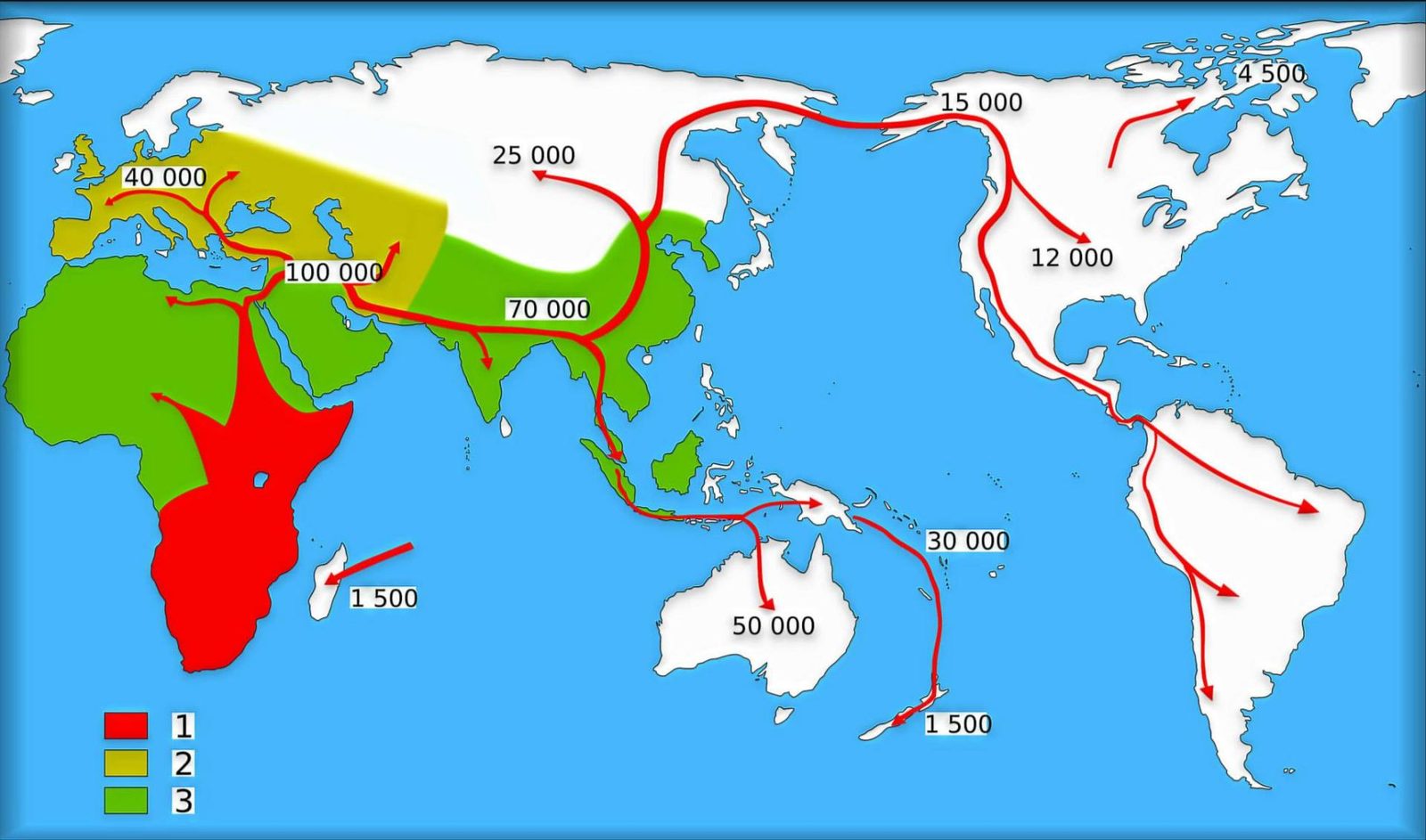
Map showing the Out of Africa migration of humanity, with red arrows tracing migration routes from Africa to every continent with dates in years before present.
Out of Africa

Every human migration on Earth traces back to Africa. From 100,000 years ago, our ancestors journeyed outward, populating every continent from a single origin.

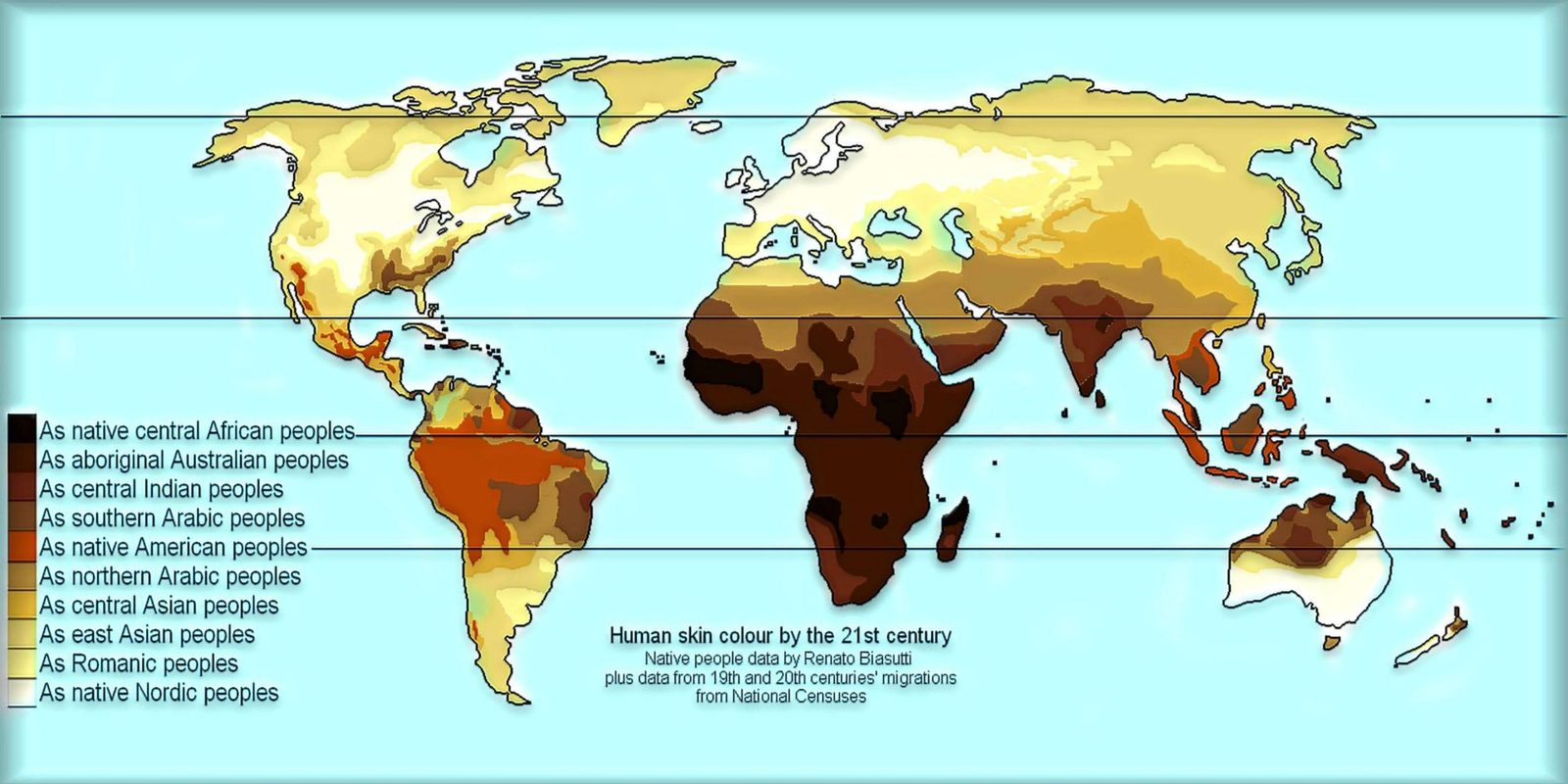
World map showing human skin colour distribution by the 21st century, demonstrating how skin pigmentation varies as a minor adaptation to environment and UV exposure.
One Species, Many Shades

Skin colour is a minor adaptation to UV exposure, not a marker of separate origins. The gradient across the globe reflects one family adapting to different environments.

"Every lineage on Earth traces back to Africa. We are one species. The evidence is written in our DNA."
II. The Civilizations

Millennia of Achievement

Long before the Maafa catastrophe that would tear the continent apart, African societies had developed state-level governance, writing systems, mathematics, architecture, medicine, astronomy, and profound ethical frameworks. Below is a fraction of that record.

200,000+ YEARS AGO

The Birth of Humanity

Homo sapiens emerge in Africa, the only continent where the full archaeological record of human evolution exists. Every human being alive today carries African DNA. Africa is not where history begins; it is where humanity begins.

Sources ▸
43,000 BCE

The Ishango Bone, Mathematics

Discovered in present-day Congo, the Ishango Bone is among the earliest known mathematical artifacts in human history. Its notched markings suggest an understanding of prime numbers and lunar cycles, mathematical thinking that predates European civilization by tens of thousands of years.

Sources ▸
5,000 – 3,000 BCE

The Rise of Kemet (Ancient Egypt)

On the banks of the Nile, Africans built one of the most sophisticated civilizations in human history. Kemet developed hieroglyphic writing, advanced mathematics and geometry, monumental architecture, medicine, astronomy, and the ethical system of Ma'at, truth, justice, balance, and reciprocity, which governed society for over three millennia.

Sources ▸
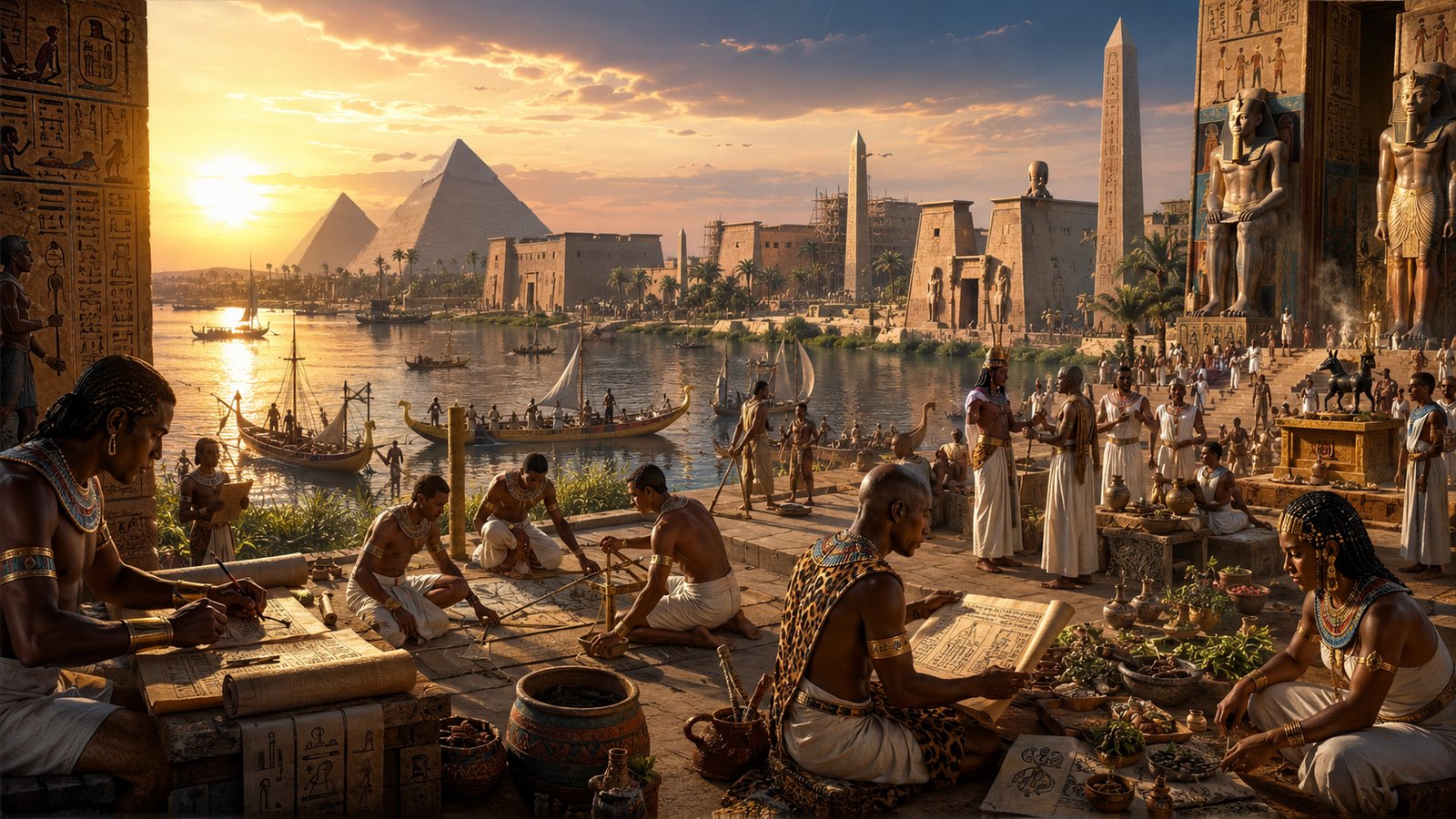
Sunset over the Nile: Kemetic scribes, artisans, and priests at work before the pyramids, obelisks, and temple statuary of ancient Egypt.
Kemet on the Nile, scribes, artisans, and priests at work beneath the pyramids and obelisks of ancient Egypt.
3,500 – 300 BCE

The Kingdom of Kush and Nubia

South of Kemet, the Kushite civilization flourished along the Upper Nile. Nubia developed its own writing system (Meroitic script), built more pyramids than Egypt, produced master ironworkers, and at times ruled Egypt itself. The 25th Dynasty of Egypt was Kushite, African rulers governing Africa's most famous civilization.

Sources ▸
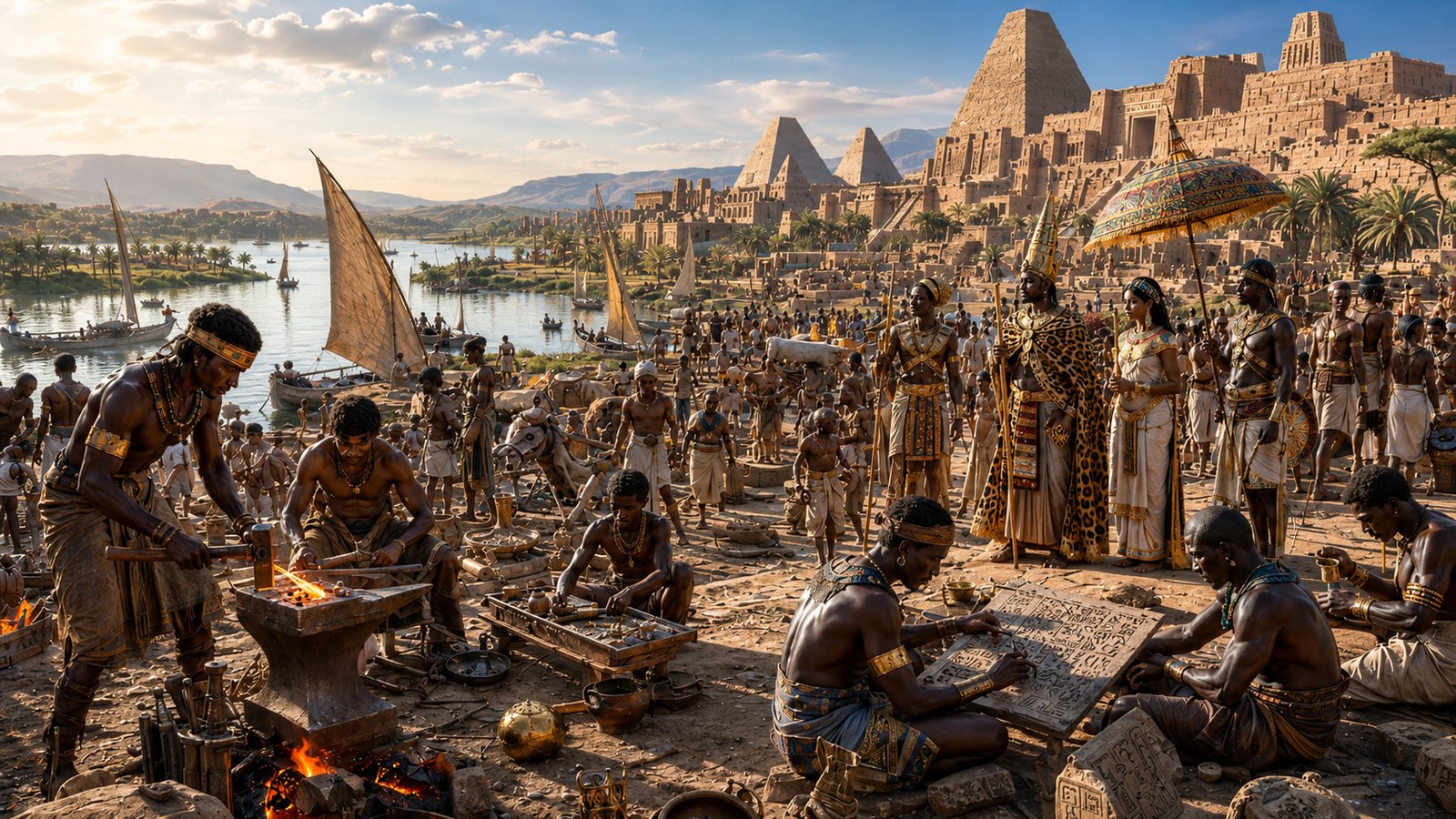
Kushite ironworkers, scribes, royalty, and Nile traders before the pyramids and palaces of Nubia.
Kush and Nubia on the Upper Nile, master ironworkers, Meroitic scribes, and Kushite royalty before the kingdom's pyramids.
1,000 BCE – 940 CE

The Kingdom of Aksum

In present-day Ethiopia and Eritrea, Aksum became one of the great powers of the ancient world. It developed its own script (Ge'ez, still used today), minted its own currency, erected towering obelisks, and was among the first states to adopt Christianity. The Persian prophet Mani named Aksum one of the four great empires of the world alongside Rome, Persia, and China.

Sources ▸
300 – 1600 CE

The Empires of West Africa, Ghana, Mali, Songhai

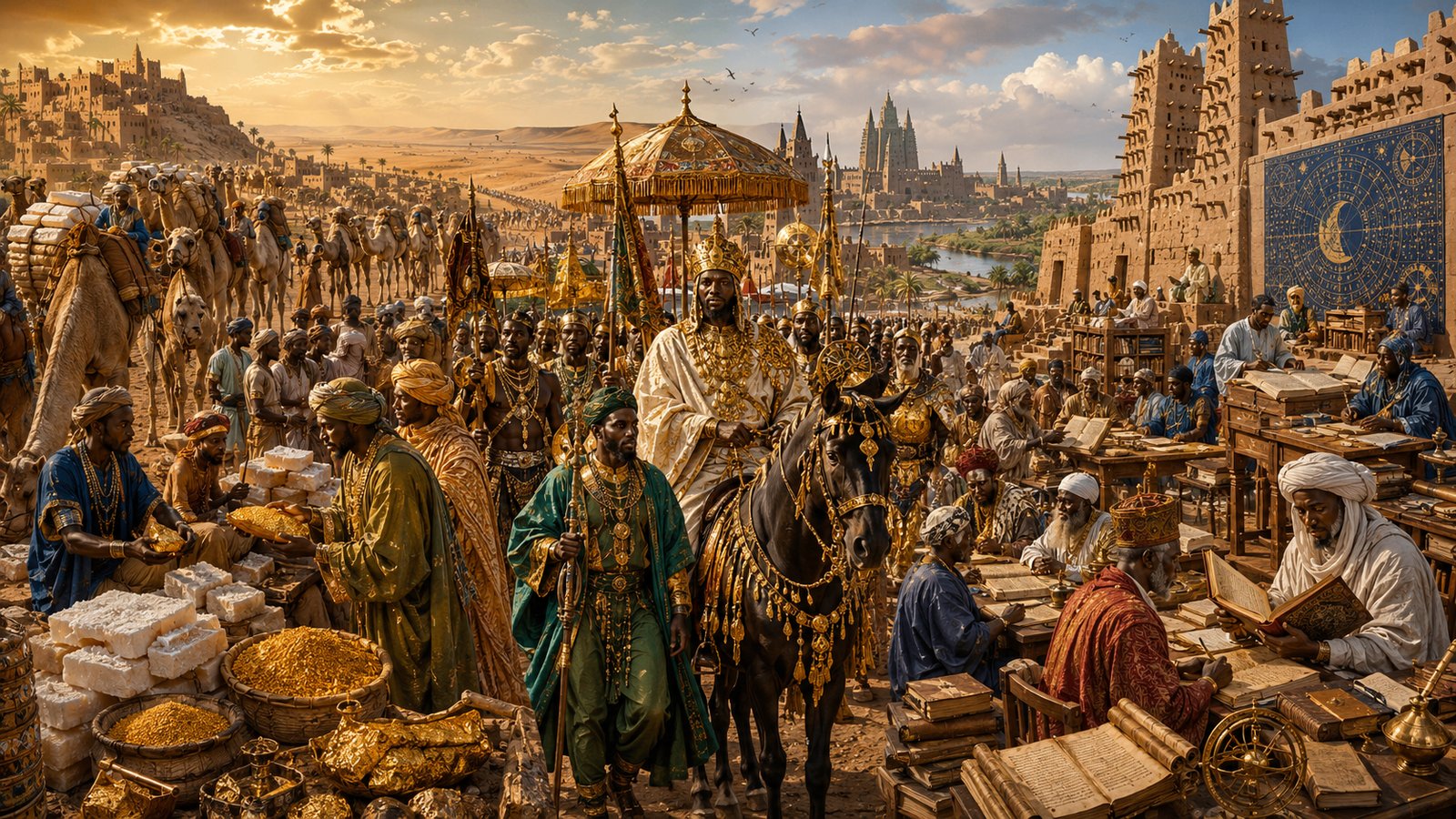
The Ghana Empire controlled trans-Saharan gold and salt trade. The Mali Empire, under Mansa Musa, became the wealthiest state on Earth, his 1324 pilgrimage to Mecca distributed so much gold it devalued the metal across the Mediterranean for a decade. The Songhai Empire built the University of Sankore at Timbuktu, which housed hundreds of thousands of manuscripts and attracted scholars from across the world.

Sources ▸
Mansa Musa and his court amid trans-Saharan caravans, gold and salt traders, and Timbuktu scholars studying astronomical manuscripts.
Ghana, Mali, and Songhai, trans-Saharan gold and salt caravans, Mansa Musa's imperial procession, and the scholars of Timbuktu.
1100 – 1450 CE

Great Zimbabwe

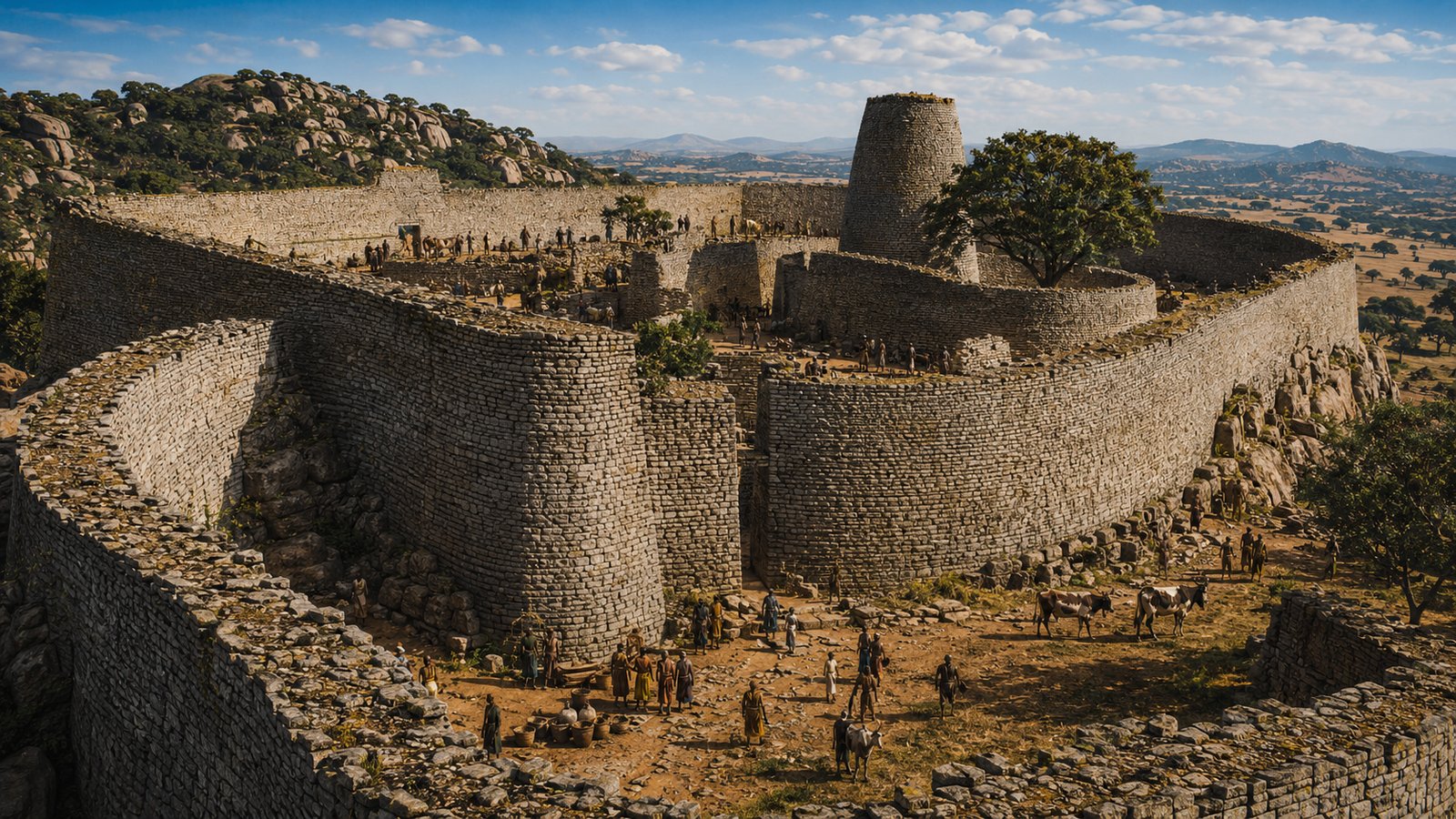
In southern Africa, the city of Great Zimbabwe was constructed entirely without mortar, its massive stone walls engineered with such precision they have stood for nearly a thousand years. When European colonizers encountered the ruins, they refused to believe Africans had built them. They were wrong. The archaeological evidence is unequivocal.

Sources ▸
The mortarless granite walls and conical tower of Great Zimbabwe on the southern African plateau, with residents and cattle in the foreground.
Great Zimbabwe, mortarless granite walls and the conical tower of a city engineered to stand a thousand years.
1200 – 1897 CE

The Kingdom of Benin

The Benin Kingdom in present-day Nigeria produced the famous Benin Bronzes, sculptures of such extraordinary artistry and technical sophistication that European art historians initially could not believe they were African. The kingdom maintained a complex political system, extensive trade networks, and architectural achievements including massive earthwork walls longer than the Great Wall of China.

Sources ▸
800 – 1500 CE

The Swahili Coast

Along the eastern African coast, Swahili city-states like Kilwa, Mombasa, and Zanzibar conducted international maritime trade with Arabia, Persia, India, and China. They built coral-stone architecture, developed a rich literary tradition, and created one of Africa's most widely spoken languages, Kiswahili, which blended Bantu foundations with Arabic influences.

Sources ▸
711 – 1492 CE

The Moors, African Civilization in Europe

Africans from North and West Africa crossed into the Iberian Peninsula and built a civilization that transformed Europe. For nearly 800 years, Moorish Spain was the most advanced society in Europe, introducing algebra, astronomy, medical science, architectural innovations, paper manufacturing, and the university system. While much of Europe languished in the Dark Ages, African-descended scholars illuminated the continent.

Sources ▸
III. The Deliberate Erasure

Manufacturing the Myth of a ' Backward Continent’

One of the most insidious legacies of the Maafa was the systematic erasure of the history of great African Civilizations. If enslaved Africans were to be classified as property, their humanity had to be denied and that denial required the erasure of African civilization from the historical record.

The myth of a ‘dark continent’ without history, without science, without culture was manufactured to justify the unjustifiable. Textbooks were rewritten. Archaeological evidence was attributed to mythical non-African builders. Languages were suppressed. Names were replaced. Drumming was banned. Teaching the enslaved to read was criminalized.

These were not accidents of ignorance. They were deliberate, systematic policies of cultural destruction designed to sever people from ancestors, knowledge, and memory so completely that human beings could be turned into legal property.

African Heritage Foundation exists to undo that erasure with indisputable historical Truth. The evidence is overwhelming. The record is clear. African civilization is one of the great achievements of the human species, and every human being alive today is its inheritor.

IV. Explore the Evidence

Databases, Archives, Documentaries, and Essential Reading

African Heritage Foundation gathers and shares this magnanimous legacy. The record of African civilization is preserved across the world's most respected academic institutions. Explore the evidence for yourself.

UNESCO SCHOLARLY COLLECTION

UNESCO General History of Africa (8 Volumes)

The most comprehensive scholarly account of African civilization ever compiled. Written by 350 scientists coordinated by 39 experts, two-thirds of them African. Nearly 10,000 pages. Free PDF access.

Download free at Internet Archive →
TRADE DATABASE

Slave Voyages, Trans-Atlantic Slave Trade Database

Documents over 36,000 slaving voyages. The most detailed quantitative record of the Maafa in existence. Searchable maps, timelines, and individual voyage records.

Visit slavevoyages.org →
PEOPLE DATABASE

Enslaved.org, Peoples of the Historical Slave Trade

A linked open data project connecting disparate archives of information about individuals who were enslaved, owned enslaved people, or participated in the trade.

Visit enslaved.org →
COMPENSATION DATABASE

UCL Legacies of British Slave-ownership

Database of British slave owners and the compensation they received upon abolition, paid to slaveholders, not the enslaved. Traces the wealth into modern institutions.

Explore at ucl.ac.uk →
WORLD HERITAGE

UNESCO World Heritage Sites in Africa

145 sites across the continent recognized for outstanding universal value, from the Pyramids of Giza to Great Zimbabwe to the Rock-Hewn Churches of Lalibela.

Browse sites →
MUSEUM COLLECTIONS

Smithsonian National Museum of African American History

The world's largest museum devoted exclusively to the documentation of African American life, history, and culture.

Visit nmaahc.si.edu →
PBS DOCUMENTARY

Africa's Great Civilizations, Henry Louis Gates Jr.

Six-part PBS series spanning 200,000 years of African history. From the birth of humankind to the dawn of the 20th century. Presented by Harvard's Professor Gates.

Watch on PBS →
BBC/UNESCO DOCUMENTARY

History of Africa, Zeinab Badawi (BBC/UNESCO)

Based on the 8-volume UNESCO General History of Africa. Sudanese-British journalist Badawi covers the origins of humanity, Kemet, Kush, Aksum, Great Zimbabwe, and the West African empires.

Watch on YouTube →
BBC DOCUMENTARY

Lost Kingdoms of Africa

British television series exploring pre-colonial African civilizations: Nubia, Ethiopia, Great Zimbabwe, West Africa, the Swahili Coast, and more. Presented by Dr. Gus Casely-Hayford.

Watch on YouTube →
CHANNEL 4 DOCUMENTARY

When the Moors Ruled in Europe

Explores the 800-year period when Africans and Muslims ruled the Iberian Peninsula, bringing science, architecture, medicine, and learning that transformed European civilization.

Watch on YouTube →
CLASSIC DOCUMENTARY

Africa, Basil Davidson Series (1984)

Eight-part series by historian Basil Davidson. Winner of the Gold Award from the International Film and Television Festival of New York. A foundational visual record of African history.

Watch on YouTube →
FOUNDATIONAL TEXT

The Destruction of Black Civilization, Chancellor Williams

First published 1971. Documents the systematic destruction of African civilizations from antiquity through colonialism. A landmark work of African-centered historiography.

View on Goodreads →
FOUNDATIONAL TEXT

The African Origin of Civilization, Cheikh Anta Diop

First published 1974. Groundbreaking scholarship proving the African (Black) origin of ancient Egyptian civilization using linguistic, anthropological, and archaeological evidence.

View on Goodreads →
CONTEMPORARY SCHOLARSHIP

An African History of Africa, Zeinab Badawi (2024)

The most important new work on African history in a generation. Badawi weaves together archaeological, genetic, and historical evidence with the voices and perspectives of African scholars and communities.

View on Goodreads →
ACADEMIC RESOURCE

World History Encyclopedia, African Civilizations

Peer-reviewed, open-access encyclopedia with detailed articles on every major African civilization. Maps, timelines, and primary source excerpts. Free to access.

Browse Africa articles →
RESEARCH CENTER

Hutchins Center for African & African American Research, Harvard

Founded by Henry Louis Gates Jr. One of the world's leading research centers on the history, culture, and social institutions of Africans and African Americans.

Visit hutchinscenter.fas.harvard.edu →
This history belongs to all of us

Every human being alive today descends from Africa. This is not the history of one people, it is the history of our entire species. To know it is to know yourself.

Carry this witness — share this page
Share